Next American City reports on a recent conference that emphasized the role of immigrants in fueling economic growth.


"Consider the statistics: Immigrants are nearly 30 percent more likely to start businesses than native-born Americans. The evidence is all over American cities. In Los Angeles, a 2005 report counted immigrants as the creators of at least 22 of the city's 100 fastest growing companies. In Boston, immigrants have fueled the resurgence of several neighborhoods, including Fields Corner, East Boston and Allston Village.
Two trends that point to immigrants playing an even more critical role in the economy of American cities in the future are their continued population growth and the ongoing move by large companies to outsource labor to distant shores. By offering jobs here in the states, immigrant entrepreneurs help to counter the job losses of outsourcing. Even during economic downturns, immigrants tend to continue to start businesses and create jobs.
But despite their crucial role in economic growth, immigrants remain a vastly ignored part of city economies and disconnected from local economic development planning, says CUF [The Center for an Urban Future].
Read the full story: The Ellis Island Economy

Silicon Valley Looks To Kill The Corner Store
A new startup is either a disruptive technology that will forever change the corner store, or yet another example of Silicon Valley looking to gentrify neighborhoods.
A Clash of Cultural Sensibilities in South Philly
Allyn Gaestel outlines the tensions that arise as a growing Vietnamese community begins to define the visual character of Washington Ave. in South Philadelphia.
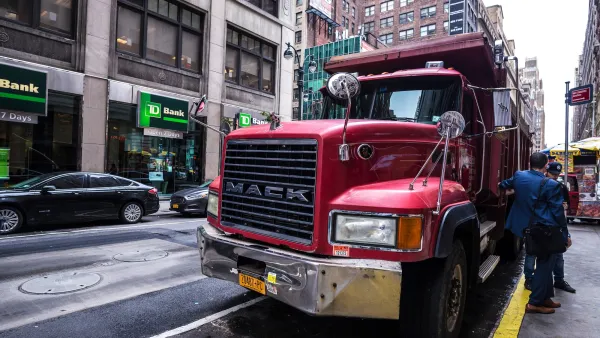
DOT withholds $73M from New York over immigrant trucking licenses
The Trump administration is requiring states to revoke the CDLs of non-domiciled drivers without proof of citizenship or risk losing federal funds.

Planetizen Federal Action Tracker
A weekly monitor of how Trump’s orders and actions are impacting planners and planning in America.

‘Going backwards:’ Baltimore mayor, students rally against state's transit funding plan
Maryland's proposed six-year plan provides no funding for Baltimore’s BMORE bus program and reduces its road maintenance funding.
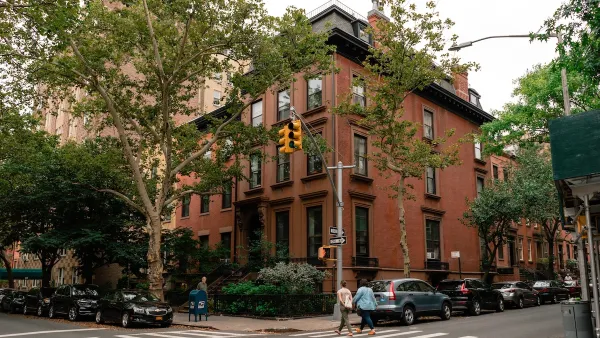
Mamdani sent nearly 6,000 pied-à-terre tax warnings to homes that didn’t qualify
A judge has ordered the administration to cancel thousands of pied-à-terre tax notices after it sent 35% of them erroneously.

Mamdani sent nearly 6,000 pied-à-terre tax warnings to homes that didn’t qualify
A judge has ordered the administration to cancel thousands of pied-à-terre tax notices after it sent 35% of them erroneously.

Detroit to transform waterfront with $2.2 billion investment
Developers will convert about 18 acres of unused parking lot space into civic spaces.

‘Going backwards:’ Baltimore mayor, students rally against state's transit funding plan
Maryland's proposed six-year plan provides no funding for Baltimore’s BMORE bus program and reduces its road maintenance funding.

FREE Course: Walkable City 1: Why Walkability?
After describing his path towards focusing on walkability as the essence of good planning, Jeff Speck marches through his five principal reasons for making more walkable places.
Reinventing Malls: Planning Alchemy—Turning Gray Fields Into Gold
The course focuses on the opportunities and imperatives that shape reinvention of mall sites.

City of Thousand Oaks
City of Wisconsin Rapids
Harvard University Graduate School of Design
The Architects Foundation
University of Cincinnati Online
Northern Illinois Transit Authority (NITA)
The Pocatello Development Authority
The Urban Renewal Agency of the City of Pocatello