Neal Peirce reflects on the happier moments of 2008 -- and a future that seems bent on creating better places and communities.


"It's time to celebrate happiness. The chemistry of positive, joyful human interaction. Physical spaces that help lighten lives."
"Another shift in 2008 could have lasting consequences for a happier society. Put briefly, it's a new premium on quality spaces. It's the death of our decades-old notion that all a city needs to do is offer developers and businesses cheap land and a complacent labor force, and that fresh investments and "success" will follow."
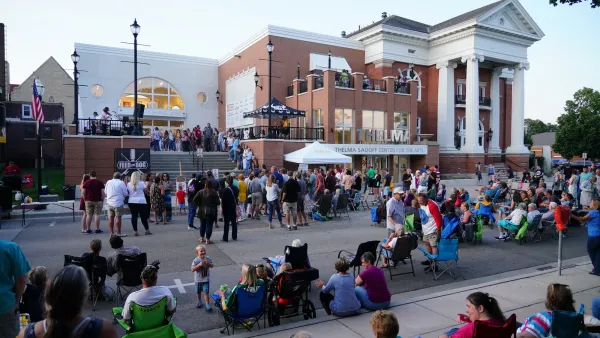
"Today there's palpable hunger for more liveliness and connectedness than isolated shopping malls, subdivisions or office parks typically offer. It's for upbeat gathering spots, coffee shops, people-filled parks, in-town concert halls, outdoor art exhibits, farmers' and Christmas markets. It's the spark of a shared civic realm that such non-profits as Partners for Livable Communities and the Project for Public Spaces have been advocating for years–their message newly popular as an entertainment-jaded nation starts to wake up what links us, not what separates us."
Read the full story: Through the Dark Clouds: Happiness in ‘08
How Placemaking Lost its Way — And How it Can Get Back on Track
The term has often become diluted, getting attached to projects that don’t live up to its lofty aspirations.

String Lights are Secular! The Holiday Case for Year-round Placemaking
The holidays make streets and spaces warm, cozy, and welcoming. Why don’t we do that year round?
“Leveraging Place”: A Toolkit for Staying Loyal to the Places We Shape
Place speaks before we plan. We need to listen.

Planetizen Federal Action Tracker
A weekly monitor of how Trump’s orders and actions are impacting planners and planning in America.

California plans to bury El Niño’s downpour
If the state plays its cards right, it may be able to store a billion acre-feet of El Niño’s water in aquifers.

Desperate measures: Advocates weigh draining Lake Powell to fill Colorado River
Draining the reservoir could reduce evaporation losses by a couple hundred thousand acre-feet.

Mamdani’s pied-à-terre tax survives legal challenge
A panel of judges found that the plaintiffs failed to demonstrate injury as a result of New York City's implementation of the tax.

Eastern Nebraska is running out of electricity
Data centers and electrification are straining eastern Nebraska’s grid, throttling economic development.

Seattle passes record-breaking transit services expansion
Proposition 1 will double the city’s transit tax to add 95,000 more bus trips and preserve 180,000 bus trips annually.

FREE Course: Walkable City 1: Why Walkability?
After describing his path towards focusing on walkability as the essence of good planning, Jeff Speck marches through his five principal reasons for making more walkable places.
Reinventing Malls: Planning Alchemy—Turning Gray Fields Into Gold
The course focuses on the opportunities and imperatives that shape reinvention of mall sites.

City of Rosemead
Rutgers University, Edward J. Bloustein School of Planning and Public Policy
One Hundred Miles
University of Michigan School for Environment and Sustainability (SEAS)
Hunter College, City University of New York (CUNY)
The Architects Foundation
City of Cambridge
Montrose County
The Pocatello Development Authority