In this Mercury News Op-Ed, San Jose State University Professor Larry Gerston proposes this bold tax for mass transit and alternative energy programs. It yields $175 billion annually and creates green jobs, enabling us to determine our destiny.


"All those discussions of a new paradigm in the form of conservation and alternative sources are washing away in less expensive oil."
[From NYT, Dec. 4: "Oil futures in New York slumped to $43.67 a barrel, their lowest point since January 2005. The price of oil has tumbled by 70 percent since settling at a peak of $145.27 on July 3..."]
"Rather than fall back to our harmful energy habits, this is the time to take bold conservation and alternative energy steps.
We need to add a gasoline consumption tax...the proceeds could be directed into two pots: one for mass transit build-outs and the other for alternative energy research and development.
The money would come quickly. The 20 million barrels of oil imported by the U.S. daily translate into 483 million gallons of gasoline. An energy tax of one dollar per gallon would capture more than $175 billion annually."
Thanks to David Schonbrunn
Read the full story: Opinion: Now is the perfect time for a dollar-a-gallon gasoline tax
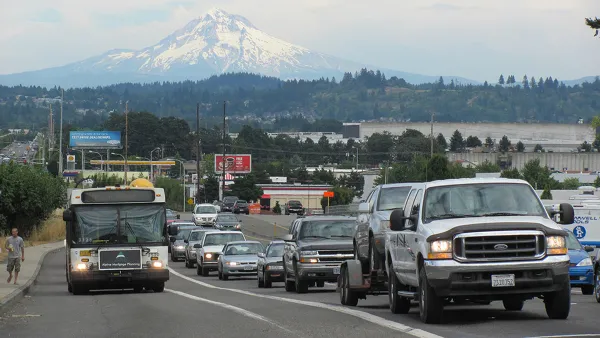
Carrots and Sticks: Making Driving Alone the Worst Option
The build out of mass transit and bicycle infrastructure hasn’t been the cure-all for shifting commuters from single-person autos to alternate modes of transit, as many had hoped. Maybe it's time we start looking at how to disincentivize driving.
The Perpetual End of Philadelphia's SEPTA
Forever plagued with issues, from lack of funding to a lack of political support, Philadelphia's SEPTA mass-transit network is (again) on the verge of collapse.
Oil Price Plunge Dampens Green Technology
The new 'oil shock' is one of plummeting oil prices and its effect on alternative technologies and energy. Combined with the credit crisis, the fallout in some green technologies is shown by difficulties in attracting capital and customers.

Planetizen Federal Action Tracker
A weekly monitor of how Trump’s orders and actions are impacting planners and planning in America.

Eastern Nebraska is running out of electricity
Data centers and electrification are straining eastern Nebraska’s grid, throttling economic development.

Washington state to charge fee to drivers with fuel-efficient cars
Revenue from the fee will go towards supporting the state’s highways.

Instead of building new housing, LA developers are turning mansions into mega-mansions
In the richest areas, the number of houses valued at $30 million with demolition permits has skyrocketed since 2018.

Illinois considers spending $1 billion in taxpayer money on data center
A quantum computing campus and data center are currently under construction in Chicago.

As development costs rise, Boston moves to lessen affordable housing requirements
The Boston Zoning Commission and the City Council still need to approve Boston Mayor Michelle Wu’s proposed changes

FREE Course: Walkable City 1: Why Walkability?
After describing his path towards focusing on walkability as the essence of good planning, Jeff Speck marches through his five principal reasons for making more walkable places.
Reinventing Malls: Planning Alchemy—Turning Gray Fields Into Gold
The course focuses on the opportunities and imperatives that shape reinvention of mall sites.

City of Charlotte
City of Rosemead
Rutgers University, Edward J. Bloustein School of Planning and Public Policy
University of Michigan School for Environment and Sustainability (SEAS)
Hunter College, City University of New York (CUNY)
The Architects Foundation
University District Partnership
City of Cambridge
The Pocatello Development Authority