An interview with Tom Skanke, president of a govt. public affairs company, about how he got involved in transportation issues and the unique challenges of moving people around in Las Vegas.


"Q. What do you consider to be the biggest transportation issue facing Southern Nevada and how do you think it should be solved?
A. Two things. One is workforce mobility. Moving, by the year 2018, which is just 10 years from now, the numbers vary, but some are between a half million and 600,000 employees, on and off Las Vegas Boulevard with the growth of the projects. You know, everybody likes to point to gaming and say it's the problem, but the last time I checked, this is a community - not a gaming community, but a community as a whole - and we all benefit from that growth. But I think if we don't institute some type of major transit component in the construct of our transportation solutions, we're going to have a huge workforce mobility problem. Nationally, it's goods movement and ports. From an economic development perspective, our commission's report says we need to build a Seattle port every year for the next 25 years to keep up with the demand of the goods that are being imported into our nation."
Read the full story: In Business Q and A: Tom Skancke

Study reveals best places in the U.S. for cycling, walking
New research from Streetlight Data examines bicycle and pedestrian miles per capita in the 100 largest U.S. cities by population.
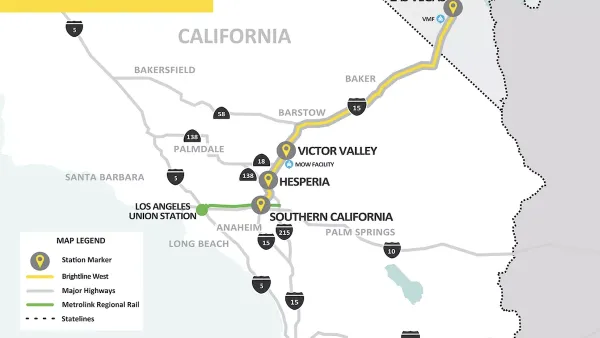
Brightline West’s future may rely on $6 billion federal loan
The company has until Nov. 2 to make a $400 million equity investment into its proposed high-speed rail line.

Nevada sues feds to block Colorado River cuts
The federal government’s newly released plan for managing the Colorado River’s dwindling water supply could cause Nevada to lose over 70% of its allocated water.

Planetizen Federal Action Tracker
A weekly monitor of how Trump’s orders and actions are impacting planners and planning in America.

Eastern Nebraska is running out of electricity
Data centers and electrification are straining eastern Nebraska’s grid, throttling economic development.
Study reveals best places in the U.S. for cycling, walking
New research from Streetlight Data examines bicycle and pedestrian miles per capita in the 100 largest U.S. cities by population.

DSA members accuse Mamdani of 'abandoning values' over housing redevelopment
New York City's mayor plans to replace about 2,000 units of public housing with private, mixed-income housing.

All sides of BRT debate unhappy with CDOT’s most recent move
The Colorado Department of Transportation is no longer considering center-running bus lanes for Colorado Boulevard.

Massachusetts bogs generate both power, and cranberries
Putting solar panels above farmland is one way Massachusetts is advancing toward its goal of net-zero carbon emissions by 2050.

FREE Course: Walkable City 1: Why Walkability?
After describing his path towards focusing on walkability as the essence of good planning, Jeff Speck marches through his five principal reasons for making more walkable places.
Reinventing Malls: Planning Alchemy—Turning Gray Fields Into Gold
The course focuses on the opportunities and imperatives that shape reinvention of mall sites.

City of Rosemead
Rutgers University, Edward J. Bloustein School of Planning and Public Policy
One Hundred Miles
University of Michigan School for Environment and Sustainability (SEAS)
Hunter College, City University of New York (CUNY)
The Architects Foundation
City of Cambridge
The Pocatello Development Authority
The Urban Renewal Agency of the City of Pocatello