Keep gas and diesel taxes stable and add new road tolls and private investment, and the road funding deficit will be solved, according to the new Bush transportation plan released July 30.


"The White House says more tolls and public-private partnerships can solve perhaps the biggest problem confronting the nation's aging infrastructure.
The administration's proposal comes as Congress gears up to start work later this year on a six-year transportation spending bill that could cost well more than $400 billion. The last multiyear bill, which expires in September 2009, carried a $286 billion tab.
Earlier this year, a bipartisan commission concluded the nation is spending only about 40% of what is needed to reduce congestion, improve safety and spur economic growth.[See related link].
Transportation Secretary Mary Peters says gas-tax rates should hold steady -- at 18.4 cents a gallon for regular gasoline and 24.4 cents a gallon for diesel, where they have stood for more than a decade -- and private money and toll revenue can address any needed increases in funding."
Thanks to Mike Keenly
Read the full story: Bush Calls for New Highway Tolls

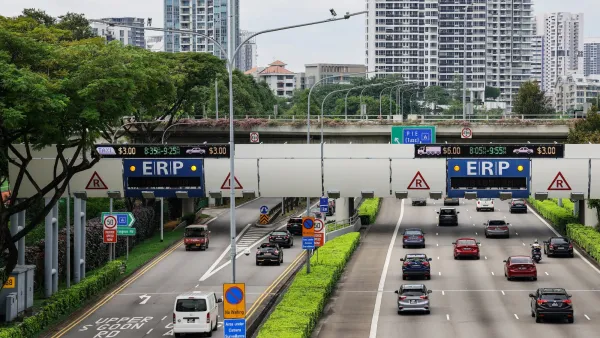
Singapore adopts in-vehicle GPS tech to manage road tolls
The city's latest update to its congestion pricing system could open the door to distance-based tolling.
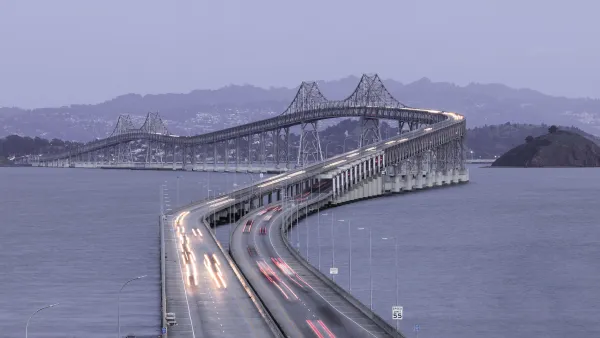
Phantom Tollbooths: Caltrans to Remove Bay Area Bridge Toll Booths Defunct Since 2020
The Richmond-San Rafael Bridge will be the first in the Bay Area to eliminate toll booths entirely in favor of open-road tolling using sensors.
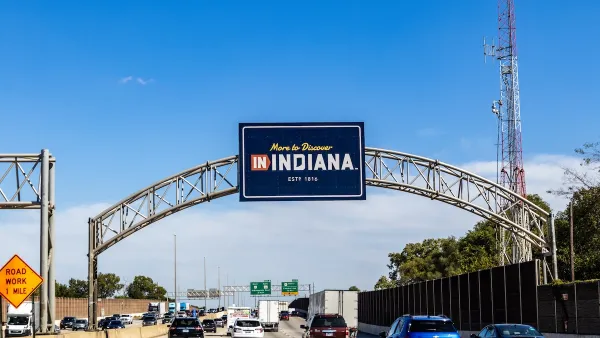
Indiana Proposes Tolls on Interstate Freeways
If the state’s request is approved by the FHWA, it would be the first to charge tolls on interstates within its borders.

Planetizen Federal Action Tracker
A weekly monitor of how Trump’s orders and actions are impacting planners and planning in America.

California plans to bury El Niño’s downpour
If the state plays its cards right, it may be able to store a billion acre-feet of El Niño’s water in aquifers.

Chicago breaks ground on $3 billion megadevelopment
The new neighborhood, titled Foundry Park, will one day host 3,700 residences.

Want to study the Missouri River? Soon, you may need unanimous approval from 10 states
Legislation would require 10 governors’ permission to study or build projects moving water outside the basin.

Desperate measures: Advocates weigh draining Lake Powell to fill Colorado River
Draining the reservoir could reduce evaporation losses by a couple hundred thousand acre-feet.

This road in NYC is infamously dangerous — and Mamdani can't fix it
New York City's Ocean Parkway is known for reckless driving, but the power to implement safety measures lies with the state rather than the city.

FREE Course: Walkable City 1: Why Walkability?
After describing his path towards focusing on walkability as the essence of good planning, Jeff Speck marches through his five principal reasons for making more walkable places.
Reinventing Malls: Planning Alchemy—Turning Gray Fields Into Gold
The course focuses on the opportunities and imperatives that shape reinvention of mall sites.

City of Rosemead
Rutgers University, Edward J. Bloustein School of Planning and Public Policy
One Hundred Miles
Hunter College, City University of New York (CUNY)
The Architects Foundation
University of Cincinnati Online
City of Cambridge
Montrose County
The Pocatello Development Authority