Riders of the New York MTA hit the transit agency with $1.2 billion in injury and damaged property claims, seriously impacting the affordability of transit.


"New York commuters, motorists and workers for the state's mass transit agency are seeking $1.2 billion in claims for injuries and damaged property, a report said on Thursday, a day after the agency warned it may have to hike fares for the second year in a row.
"It's about safety and savings," state Comptroller Thomas DiNapoli said, noting the Metropolitan Transportation Authority already has paid out more than $1.1 billion on these kinds of claims since 1996. "The costs to settle judgments and claims will remain a significant budget expense," the Democrat added.
On Wednesday, the authority's executive director, Elliott Sander, warned Albany legislators that a funding shortfall could force the MTA to boost fares by 25 cents."
Read the full story: N.Y. MTA riders, staff seek $1.2 bln in damages
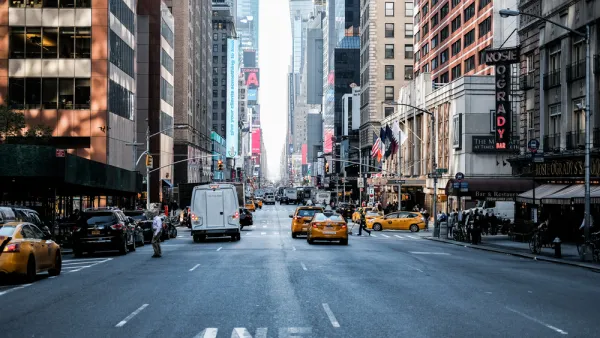
Learning from Manhattan's Urban Imperfections
New York is a great city that breaks many rules of urban planning. Here's what its imperfections can teach us about city building.

Op-Ed: Congestion Pricing Offers New York a 'Promising Path Forwards'
New York State Budget Director Robert Mujica penned a Sunday op-ed for the Daily News on the benefits of congestion pricing. On Tuesday, Gov. Cuomo broke the news on WNYC that he and Mayor de Blasio agreed on tolling the central business district.
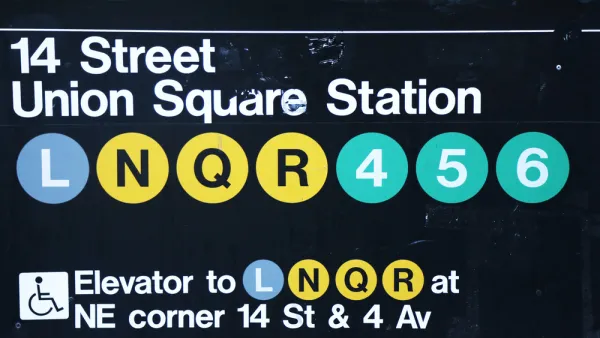
How the New L Train Repair Plan Will Work
After the initial shock of Governor Andrew Cuomo's cancellation of the planned L Train closure subsided, analysis and commentary rolled in.

Planetizen Federal Action Tracker
A weekly monitor of how Trump’s orders and actions are impacting planners and planning in America.

California plans to bury El Niño’s downpour
If the state plays its cards right, it may be able to store a billion acre-feet of El Niño’s water in aquifers.

Desperate measures: Advocates weigh draining Lake Powell to fill Colorado River
Draining the reservoir could reduce evaporation losses by a couple hundred thousand acre-feet.

Los Angeles just elected an urban planner as its mayor
Transportation analysts are optimistic that Raman will be more aggressive in addressing transit issues than Bass.

Mamdani’s pied-à-terre tax survives legal challenge
A panel of judges found that the plaintiffs failed to demonstrate injury as a result of New York City's implementation of the tax.

Eastern Nebraska is running out of electricity
Data centers and electrification are straining eastern Nebraska’s grid, throttling economic development.

FREE Course: Walkable City 1: Why Walkability?
After describing his path towards focusing on walkability as the essence of good planning, Jeff Speck marches through his five principal reasons for making more walkable places.
Reinventing Malls: Planning Alchemy—Turning Gray Fields Into Gold
The course focuses on the opportunities and imperatives that shape reinvention of mall sites.

City of Rosemead
Rutgers University, Edward J. Bloustein School of Planning and Public Policy
One Hundred Miles
University of Michigan School for Environment and Sustainability (SEAS)
Hunter College, City University of New York (CUNY)
The Architects Foundation
City of Cambridge
Montrose County
The Pocatello Development Authority