Record gas prices have helped the nation's transit systems attract record numbers of riders. Notably, the biggest increases have occurred in the South and West, where public transportation has traditionally been underutilized.


"With the price of gasoline approaching $4 a gallon, more commuters are leaving their cars at home and taking trains or buses.
Mass-transit systems nationwide are seeing standing-room-only crowds on bus lines where seats once were easy to come by. Parking lots at many bus and light-rail stations suddenly are overflowing with commuters in some towns.
"In almost every transit system I talk to, we're seeing very high rates of growth the last few months," said William Millar, president of the American Public Transportation Association. "It's very clear that a significant portion of the increase in transit use is directly caused by people who are looking for alternatives to paying $3.50 a gallon for gas."
Some cities with long-established public-transit systems, such as New York and Boston, have seen increases in ridership of 5 percent or more this year. But the biggest surges - of 10 to 15 percent or more in the past year - are occurring in many metropolitan areas in the South and West, where the driving culture is strongest and bus and rail lines are more limited."
Read the full story: As gas prices soar, more commuters hop buses, trains

It's Dump the Pump Day
Today is "Dump the Pump" Day, an annual event created by the American Public Transportation Association to bring awareness to the benefits of public transit. Transit agencies across the country are offering free rides, including many in Florida.
Transit Struggling To Keep Up
Transit use is surging, but operators are facing the same fuel crunch as consumers and public monies for new investments aren't up to addressing the new demand.
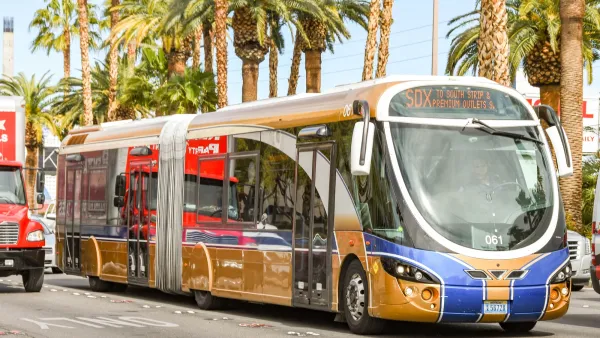
Two out of three transit riders in Las Vegas don't own a car
As gas and insurance prices rise, car commuting is becoming more unaffordable to working Americans, leaving them reliant on their local transit systems.

Planetizen Federal Action Tracker
A weekly monitor of how Trump’s orders and actions are impacting planners and planning in America.

The state-sanctioned urbicide of Austin
People don’t kill cities. Freeways do.

US to reduce Colorado River water deliveries to Mexico
A new Colorado Treaty amendment reduces Mexico’s Colorado River water allocation by 250,000 acre feet.

Nation's most wind-powered state turns to coal as data centers increase energy demand
For the first time in decades, Iowa has increased its generation of coal power.

NYC cools commuters with city's first rain garden above a bus stop
New York City officials say the plants in the rain garden can absorb 16 gallons of rainwater during heavy storms.

Brightline West’s future may rely on $6 billion federal loan
The company has until Nov. 2 to make a $400 million equity investment into its proposed high-speed rail line.

FREE Course: Walkable City 1: Why Walkability?
After describing his path towards focusing on walkability as the essence of good planning, Jeff Speck marches through his five principal reasons for making more walkable places.
Reinventing Malls: Planning Alchemy—Turning Gray Fields Into Gold
The course focuses on the opportunities and imperatives that shape reinvention of mall sites.

Greater Baltimore Committee
Eagle County Government
Harvard University Graduate School of Design
The Architects Foundation
University of Cincinnati Online
The Pocatello Development Authority
The Urban Renewal Agency of the City of Pocatello
Journal of the American Planning Association