Officials in Youngstown, Ohio, hope to save money and strengthen their community by vacating sparsely populated neighborhoods, but homeowners in the targeted areas are reluctant to leave -- even with the city's $50,000 incentives.


"When the city of Youngstown, Ohio, proposed incentives to move people out of declining neighborhoods, it sounded like a good idea - in theory.
The city hoped to lure holdouts living on nearly empty blocks and relocate them to more lively areas, as part of its plan to remake itself in the wake of the steel industry's departure and the foreclosure crisis. It's already cleared some lots for things like playgrounds.
Now Youngstown wants to close entire streets and bulldoze abandoned properties so it can shut down city services like street lighting, police patrols and garbage pick-ups that it can no longer afford to maintain.
To do this on a large scale, the city needs to get about 100 residents to relocate. Each is eligible for $50,000 in incentives - plenty, in this town, to buy a new home and move. The hitch: Youngstowners don't seem to want to leave their homes, no matter how blighted or abandoned the neighborhood may be."
Thanks to John Byrne
Read the full story: You Can't Pay Them Enough to Leave
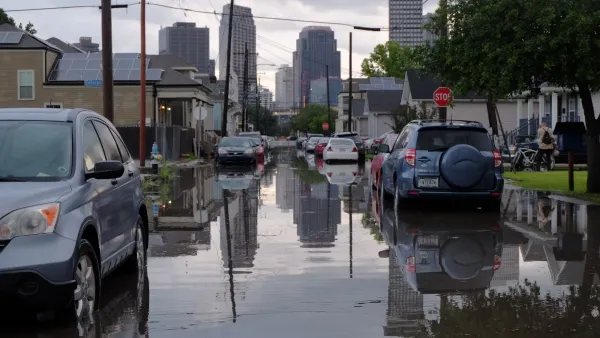
Study: New Orleans sea level rise is at 'point of no return'
Research shows that the city could be surrounded by water by the end of this century.
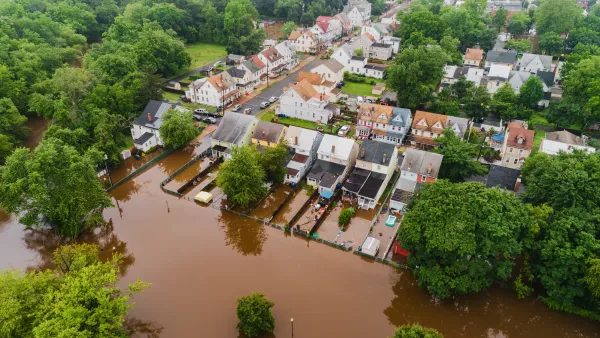
New Jersey Buyout Program Turns Flood-Prone Properties Into Green Buffer Zones
For 30 years, The Blue Acres program has offered homeowners in high-risk flood zones the chance to relocate, preserving land as open space.

Sea Level Rise is Drowning This Pacific Island Nation; They Have a Plan
The nation of Tuvalu has created an ambitious plan to relocate its entire population and preserve key cultural and historic resources as rising seas threaten to wipe it out within three decades.

Planetizen Federal Action Tracker
A weekly monitor of how Trump’s orders and actions are impacting planners and planning in America.

Eastern Nebraska is running out of electricity
Data centers and electrification are straining eastern Nebraska’s grid, throttling economic development.

Study reveals best places in the U.S. for cycling, walking
New research from Streetlight Data examines bicycle and pedestrian miles per capita in the 100 largest U.S. cities by population.

Next-generation nuclear reactors are coming to Texas
The reactors will not require towering containment structures thanks to new safety features.

California distributes $1.3 billion to prevent transit service cuts, bolster projects
Twenty-eight projects across California received a portion of the funding.

Pennsylvania Democrats have 15 affordability, clean energy bills for flipped state Senate
Bills in consideration include a bill supporting geothermal energy and a bill supporting solar on warehouses.

FREE Course: Walkable City 1: Why Walkability?
After describing his path towards focusing on walkability as the essence of good planning, Jeff Speck marches through his five principal reasons for making more walkable places.
Reinventing Malls: Planning Alchemy—Turning Gray Fields Into Gold
The course focuses on the opportunities and imperatives that shape reinvention of mall sites.

City of Charlotte
City of Rosemead
Rutgers University, Edward J. Bloustein School of Planning and Public Policy
University of Michigan School for Environment and Sustainability (SEAS)
Hunter College, City University of New York (CUNY)
The Architects Foundation
City of Cambridge
The Pocatello Development Authority
The Urban Renewal Agency of the City of Pocatello