While the American Dream Coalition celebrates the 'freedom and affordability' of Houston -- Robert Steuteville wonders why the group ignores the environmental and financial consequences of such an auto-dependent city.


"I hold no personal grudge against Houston. I'm agnostic about its lack of zoning - I'm no fan of development regulations that have fostered sprawl throughout the US in the last six decades. I applaud compact development in downtown Houston and efforts to build New Urbanism in the city (Duany Plater-Zyberk designed three projects in 2007 and other new urbanists are working in Houston as well).
That said, Houston is no place for the rest of the nation to emulate in terms of land use policies."
"Given the lack of transportation choices, moderate-income families in Houston have little alternative to pouring nearly a third of their pay into automotive expenses. Unlike housing, which can build household equity, transportation dollars go down the gas tank. With rising oil prices during the last eight years, this problem is getting steadily worse."
"I don't mean to pick on Houston. There's sprawl everywhere in America. I have hopes that Houston, like the rest of the US, can change. My problem is with a group bent on perpetuating automobile and oil dependency, and foisting a potentially catastrophic global warming on future generations. That sounds to me like an American nightmare."
Thanks to The Intrepid Staff
Read the full story: Houston, we have a problem
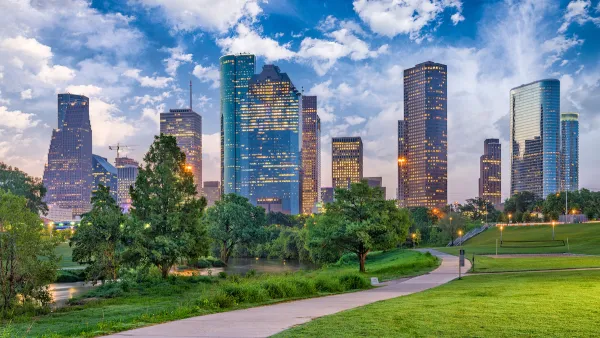
Promoting Infill Development for a Denser Houston
An advocacy group is calling for ‘sustainable, vertical’ mixed-use urbanism in the famously sprawling city.
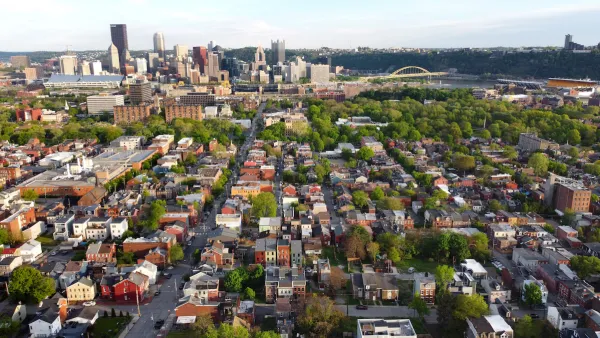
A Better Understanding of Smart Growth Benefits
Smart Growth creates compact, multimodal communities where residents consume less land, drive less, and rely more on non-auto modes. Planners have important stories to tell about the benefits of Smart Growth.
A Primer on Suburban Urbanism
How one master-planned development used lower-density urbanism principles to build a community focused on affordability, sustainability, and conservation.

Planetizen Federal Action Tracker
A weekly monitor of how Trump’s orders and actions are impacting planners and planning in America.

California plans to bury El Niño’s downpour
If the state plays its cards right, it may be able to store a billion acre-feet of El Niño’s water in aquifers.

Desperate measures: Advocates weigh draining Lake Powell to fill Colorado River
Draining the reservoir could reduce evaporation losses by a couple hundred thousand acre-feet.

Housing is the top priority of Seattle’s sole new councilmember
Jenks campaigned on building 1,000 new units of affordable housing.

New tax cuts may slash $1.5 billion in funding for Miami transit, public parks
Amendment 3 will save Miami-Dade homeowners $2,700 in 2028.

Arizona, Wisconsin, Pennsylvania hope to finally advance climate goals post-midterms
The three states have spent years under Republican or divided control.

FREE Course: Walkable City 1: Why Walkability?
After describing his path towards focusing on walkability as the essence of good planning, Jeff Speck marches through his five principal reasons for making more walkable places.
Reinventing Malls: Planning Alchemy—Turning Gray Fields Into Gold
The course focuses on the opportunities and imperatives that shape reinvention of mall sites.

City of Rosemead
Rutgers University, Edward J. Bloustein School of Planning and Public Policy
One Hundred Miles
University of Michigan School for Environment and Sustainability (SEAS)
Hunter College, City University of New York (CUNY)
The Architects Foundation
City of Cambridge
Montrose County
The Pocatello Development Authority