This article from Metropolis Magazine features a tour of Beijing as it prepares for the Summer Olympics. The scale of development is almost overwhelming, according to author Philip Nobel.


"It took a visit to that nondescript addition for me finally to see what is possible when modern technology, capitalist zeal, Communist control, national ambition, and a bottomless unprotected labor pool combine in the service of building. You can get things done. That moment also opened up for me the profound strangeness of the city. The shoulder-to-shoulder towers on the wide ring roads that give each the scale of Las Vegas Boulevard? All brand new. The wooded margins of every highway? The elaborately greened interchanges? All fresh, and all false, every tree imported and planted to mask Beijing's essential filthiness in advance of the coming-out party planned there this summer."
"The Olympic site itself no longer seemed like a lost cause. Touring it before, I thought there was no way the buildings would be finished and the vast dust bowl paved and tricked out with its planned parks, roads, and watercourses before the games began on August 8. It certainly will be-Herzog & de Meuron's intoxicating "Bird's Nest" stadium is now in punch list-but such sprinting has a cost. The New York Times reported in late January that six construction workers have died on Olympic sites in the last five years; the Times of London had previously put the number at ten. A long article on the official Beijing 2008 Web site was posted in early February, likely in response to all the bad press. The protesting-too-much begins with the headline, 'Workers Enjoy Good Services at Olympic Venue Sites.'"
"The current transformation of Beijing also includes the wholesale razing of many of the old residential quarters in the central city, the residents themselves relocated to vast new tower blocks on the urban edge-deluxe hutongs in the sky-or simply made homeless without contingency. Several of the old neighborhoods along the tourist routes near the Forbidden City have been preserved in sterilized form. But there's little opportunity here for outsider self-righteousness; the effects of such changes are not very different than they would be in any American city: low-rent buildings replaced by expensive ones through economic churn, people displaced, quaint neighborhoods locked in amber. Though having two invisible hands-the will of an all-powerful government plus the inexorable pressure of capital-seems to streamline the process."
Read the full story: Delirious Beijing

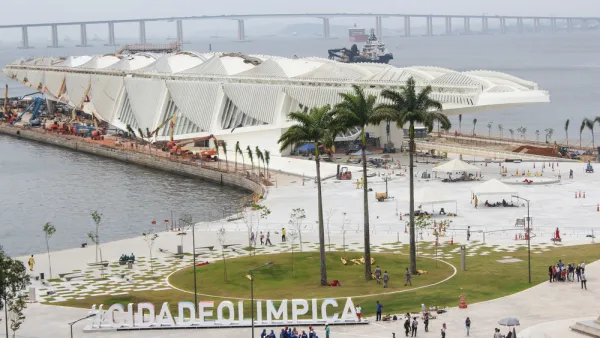
Abandoned Olympic Venues Cast Doubt on the Value of Hosting
Though cities hope for an economic boost, these photos show it's far from guaranteed.
Can Madrid's Bid for a Thrifty Olympics Succeed?
As the start of London's summer games grows near, the competition to host the 2020 Olympics is heating up. Paul Sonne looks at whether the "shoestring" bid of Madrid, formed amidst Spain's austerity drive, can beat out the other finalists.
Winter Wonderland in the Bird's Nest
This slideshow from the BBC explores how Beijing's iconic Bird's Nest Olympic stadium is being reused -- as a kids theme park.

Planetizen Federal Action Tracker
A weekly monitor of how Trump’s orders and actions are impacting planners and planning in America.

Amtrak, CN end decades-long dispute with eight-year agreement
The new operating agreement establishes an updated framework for the companies to work together, including processes to resolve disputes.

Northwest rail fans eager for Sept. 30 debut of Amtrak’s Airo fleet
Get ready for that new train smell and more seats. But they won’t go faster or run more frequently on the Cascades route in Washington and Oregon.

St. Louis Metro to test if single-car trains can reduce operating costs, maintain rider satisfaction
The pilot program will run from October to spring 2027, and begin with one single-car train operating on Metrolink’s Red and Blue lines.

Pennsylvania is building data centers in abandoned mines
Housing data centers in mines provides an alternative to destroying local forests and may spare residents from data centers’ noise and air pollution.

If Corpus Christi can’t revive desalination plant project, it may owe Texas $235 million
Earlier this month, city officials declined to pursue developing the plant for the second time in a year.

FREE Course: Walkable City 1: Why Walkability?
After describing his path towards focusing on walkability as the essence of good planning, Jeff Speck marches through his five principal reasons for making more walkable places.
Reinventing Malls: Planning Alchemy—Turning Gray Fields Into Gold
The course focuses on the opportunities and imperatives that shape reinvention of mall sites.

City of Thousand Oaks
City of Wisconsin Rapids
Harvard University Graduate School of Design
The Architects Foundation
University of Cincinnati Online
The Pocatello Development Authority
The Urban Renewal Agency of the City of Pocatello