The city of San Francisco is considering a proposal to require most new commercial and residential buildings to comply with the green building standard LEED.


"A proposed green building ordinance in San Francisco would transform the construction industry across northern California, impacting everything from city paint shops and local subcontractors to suburban neighborhoods resistant to sand pits and gravel quarries."
"If passed in March, the ordinance would require most new commercial and residential high-rises to meet Leadership in Energy and Environmental Design (LEED) standards. Under LEED, developers must earn credits from a checklist of building practices that reduce the project's carbon footprint."
"A number of cities and states, such as New Mexico and Washington, have adopted LEED for public buildings, but San Francisco would mandate it for the private sector as well. San Francisco officials say they want to get tough because the operation and construction of buildings account for half the city's CO2 footprint. If passed, the ordinance would be the most far-reaching in the US."
Read the full story: San Francisco weighs green-building law
Plenty Green But Too Tall?
In what may prove a decisive test to see the political limits of what green building offers developers, a LEED Platinum, 10-story office building is proposed along San Francisco's tightly regulated waterfront - exceeding the height limit by 40 feet.
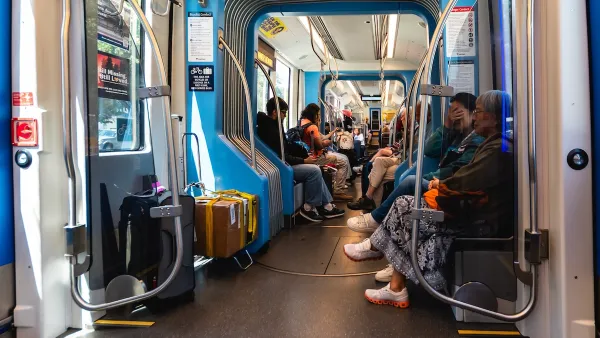
Voters choose public transit, approve $31 billion in funding
Approved projects include $101,000 for reduced-cost transit in a Michigan town and $14 billion for regional transit in the San Francisco Bay Area.
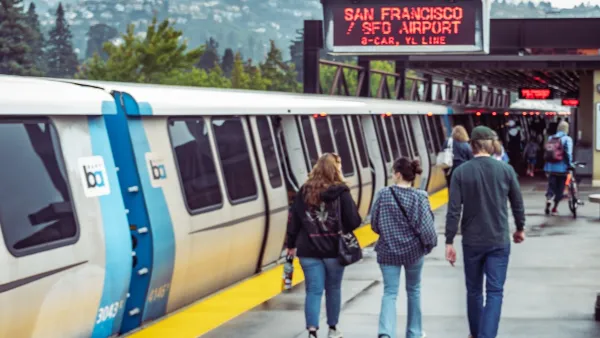
Bay area voters pass ‘crucial lifeline’ for transit
Proposition RTM, which will fund Bay Area transit, has approval from 61% of voters as of 9:45 p.m. on Nov. 3.

Planetizen Federal Action Tracker
A weekly monitor of how Trump’s orders and actions are impacting planners and planning in America.

Eastern Nebraska is running out of electricity
Data centers and electrification are straining eastern Nebraska’s grid, throttling economic development.

Move over, LA: St. Louis gears up for Olympics, invests millions in downtown redevelopment
The Missouri city will host the 2028 Olympic soccer group stage and knockout matches.

Dallas releases zoning code overhaul to officials
The drafted overhaul is over 400 pages long.

NYC renovations for dangerous, ‘mercilessly crammed’ street delayed until 2027
Construction was supposed to begin this fall.

San Diego’s Midway Rising project gets greenlight from city council
The project looks to become the largest affordable housing development in California's history.

FREE Course: Walkable City 1: Why Walkability?
After describing his path towards focusing on walkability as the essence of good planning, Jeff Speck marches through his five principal reasons for making more walkable places.
Reinventing Malls: Planning Alchemy—Turning Gray Fields Into Gold
The course focuses on the opportunities and imperatives that shape reinvention of mall sites.

City of Rosemead
Rutgers University, Edward J. Bloustein School of Planning and Public Policy
One Hundred Miles
University of Michigan School for Environment and Sustainability (SEAS)
Hunter College, City University of New York (CUNY)
The Architects Foundation
City of Cambridge
The Pocatello Development Authority
The Urban Renewal Agency of the City of Pocatello