Cities will be allowed to lower speed limits to 10 miles per hour and prioritize pedestrians on certain streets.


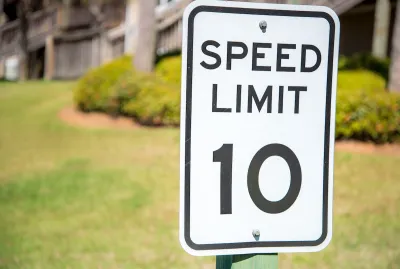
Washington Governor Bob Ferguson signed a bill that allows cities to create “shared streets” with speed limits of 10 miles per hour that allow pedestrians to use the middle of the street.
As Mark Ostrow explains in The Urbanist, Senate Bill 5595 eliminates jaywalking laws on shared streets, giving pedestrians true priority. For Ostrow, “Shared streets have the potential to dramatically change the way we move around cities in the state of Washington.”
The model, common in Europe and Asia, allows for multiple traffic modes while improving safety for all users. “Residents use shared streets as an extension of their homes, cafes spill into the street, and children move about freely.”
Ostrow offers examples from global cities, showing how even wide boulevards can become pedestrian-oriented corridors. Ostrow cites three key characteristics of successful shared streets: low speed limits, the legal right for pedestrians to use the entire street, and “a physical design compatible with the other two.” Washington’s SB 5595 offers the first two — but not the third, Ostrow notes. It will be up to cities to bring infrastructure up to a safe standard to make streets truly safe and walkable.
FULL STORY: Governor Signs Washington’s First-in-the-Nation Shared Streets Law


The number of kids walking to school dropped from over 50% to 11% since the 1960s
Unsafe pedestrian infrastructure makes walking to school dangerous or impossible for a growing number of American students.
Seattle Creates 4 ‘Low-pollution Neighborhoods’
The pilot program is designed to reduce air pollution and increase access to transit and safe walking and biking infrastructure.
Why Walk Scores Don’t Tell the Whole Story
A popular measure of walkability only measures proximity, not safety or comfort.

Planetizen Federal Action Tracker
A weekly monitor of how Trump’s orders and actions are impacting planners and planning in America.

The state-sanctioned urbicide of Austin
People don’t kill cities. Freeways do.

US to reduce Colorado River water deliveries to Mexico
A new Colorado Treaty amendment reduces Mexico’s Colorado River water allocation by 250,000 acre feet.

5 New England states march closer to 800 megawatt wind energy project
Securing federal approval for the project may be complicated under the Trump administration, which has historically been hostile towards domestic wind power.

Baltimore to break ground on $50 million Transit Priority Project
The project will bring faster bus trips, safer streets and better bike connections to Baltimore.

Airbnb launches $250 million 'last-dollar financing' housing accelerator, makes first investment in Austin
The company will put $6.4 million towards affordable housing development in Texas’ capital.

FREE Course: Walkable City 1: Why Walkability?
After describing his path towards focusing on walkability as the essence of good planning, Jeff Speck marches through his five principal reasons for making more walkable places.
Reinventing Malls: Planning Alchemy—Turning Gray Fields Into Gold
The course focuses on the opportunities and imperatives that shape reinvention of mall sites.

Eagle County Government
Harvard University Graduate School of Design
Nashville Planning Department
The Architects Foundation
University of Cincinnati Online
The Pocatello Development Authority
The Urban Renewal Agency of the City of Pocatello
Journal of the American Planning Association