An explainer from Momentum highlights the advantages of reducing vehicle lanes in favor of more bike, transit, and pedestrian infrastructure.


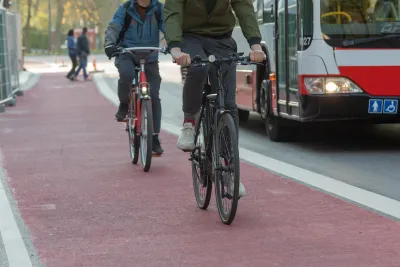
An explainer from Momentum Magazine outlines the benefits of road diets, a popular but controversial traffic calming strategy that focuses on reducing the number of vehicle lanes and adding sidewalks and other bike and pedestrian infrastructure to streets.
According to author Ron Johnson, “ The first road diet in the United States was implemented in 1979 in Billings, Montana. Since then, cities like Charlotte, Chicago, San Francisco, and New York have all embraced the model. But it’s not just a design trend—road diets are backed by powerful data and safety results.”
Reducing the number of lanes and average speeds can cut crashes by as much as 52 percent, and slower speeds also mean crashes can be less serious when they do occur.
Although road diet opponents worry about traffic, “Removing travel lanes can actually lead to a reduction in overall vehicle trips—a phenomenon known as traffic evaporation. Some drivers shift to alternative routes or, increasingly, to alternative modes of transport.” Better bike and pedestrian infrastructure incentivizes more people to use those modes, and bus lanes make transit a more reliable option. Road diets thus also lead to reduced carbon emissions and cleaner air.
“As our cities continue to evolve, road diets offer a cost-effective, data-backed, and scalable way to make them safer, cleaner, and more livable,” Johnson concludes.
FULL STORY: Explainer: What Is a Road Diet—And Why Should Cities Embrace It?

Houston Residents Respond to Mobility Questions
What could the city look like if budget and bureaucracy were no object?
Trump Killed Funding for Milwaukee's Dreamy Multimodal Street. They're Determined to Make it Happen Anyway.
The administration rescinded a $36 million Reconnecting Communities grant aimed at redesigning a 2.6-mile segment of 6th Street.
Indy Neighborhood Group Builds Temporary Multi-Use Path
Community members, aided in part by funding from the city, repurposed a vehicle lane to create a protected bike and pedestrian path for the summer season.

Planetizen Federal Action Tracker
A weekly monitor of how Trump’s orders and actions are impacting planners and planning in America.

The state-sanctioned urbicide of Austin
People don’t kill cities. Freeways do.

US to reduce Colorado River water deliveries to Mexico
A new Colorado Treaty amendment reduces Mexico’s Colorado River water allocation by 250,000 acre feet.

5 New England states march closer to 800 megawatt wind energy project
Securing federal approval for the project may be complicated under the Trump administration, which has historically been hostile towards domestic wind power.

Baltimore to break ground on $50 million Transit Priority Project
The project will bring faster bus trips, safer streets and better bike connections to Baltimore.

Airbnb launches $250 million 'last-dollar financing' housing accelerator, makes first investment in Austin
The company will put $6.4 million towards affordable housing development in Texas’ capital.

FREE Course: Walkable City 1: Why Walkability?
After describing his path towards focusing on walkability as the essence of good planning, Jeff Speck marches through his five principal reasons for making more walkable places.
Reinventing Malls: Planning Alchemy—Turning Gray Fields Into Gold
The course focuses on the opportunities and imperatives that shape reinvention of mall sites.

Eagle County Government
Harvard University Graduate School of Design
Nashville Planning Department
The Architects Foundation
University of Cincinnati Online
The Pocatello Development Authority
The Urban Renewal Agency of the City of Pocatello
Journal of the American Planning Association