With help from community partners like the Trust for Public Land, Oakland Unified School District is turning barren, asphalt-covered schoolyards into vibrant, green spaces that support outdoor learning, play, and student well-being.


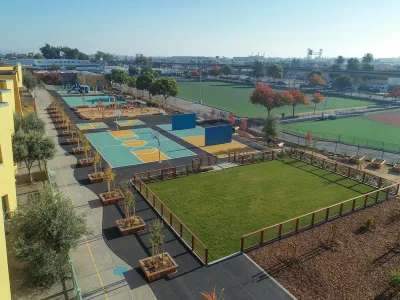
Across the country, many K-12 schoolyards are dominated by heat-absorbing concrete, with little vegetation or opportunity for outdoor learning. In Oakland, California, the school district faced the same budget pressures as many others—prioritizing classroom upgrades, air quality improvements, and deferred maintenance over outdoor improvements. However, thanks to external partnerships like the one with the Trust for Public Land, the Oakland Unified School District has successfully begun transforming these concrete spaces into vibrant, green schoolyards.
With support from the Trust for Public Land, Oakland has completed 20 green schoolyard projects and planted nearly 475 trees, with plans to expand even further this year. Community engagement has been vital, with design input coming from students and the public — leading to creative, student-centered outdoor spaces. Though not every idea (like smoothie bars and water slides) made the cut, the collaboration created spaces that students are excited to use. In one instance, more than 200 volunteers completed a schoolyard transformation in just three days, demonstrating strong community investment.
The shift to greener schoolyards has brought numerous benefits beyond aesthetics. Students and staff enjoy cooler spaces, improved engagement, fewer disciplinary issues, and more opportunities for learning and recreation. Key features of these spaces include native gardens, stormwater capture systems, nature play zones, and outdoor classrooms. A central lesson from Oakland’s success is the importance of outside funding and civic-minded partners, proving that sustainable schoolyards are achievable when communities rally behind them.
FULL STORY: Green Schoolyards Help Accomplish Sustainability Goals


Advancing Sustainability in Los Angeles County Schools
The Los Angeles County Office of Education’s Green Schools Symposium brings together educators, students, and experts to advance sustainability in schools through innovative design, climate resilience strategies, and collaborative learning.
Alabama School Forestry Initiative Brings Trees to Schoolyards
Trees can improve physical and mental health for students and commnity members.

Pittsburgh Rolls Out Electric School Buses
Pittsburgh Public Schools has launched its first electric school buses, with plans to fully electrify its fleet over the next 14 months, aiming to create a cleaner, more sustainable transportation system supported by new charging infrastructure.

Planetizen Federal Action Tracker
A weekly monitor of how Trump’s orders and actions are impacting planners and planning in America.

The state-sanctioned urbicide of Austin
People don’t kill cities. Freeways do.

US to reduce Colorado River water deliveries to Mexico
A new Colorado Treaty amendment reduces Mexico’s Colorado River water allocation by 250,000 acre feet.

5 New England states march closer to 800 megawatt wind energy project
Securing federal approval for the project may be complicated under the Trump administration, which has historically been hostile towards domestic wind power.

Baltimore to break ground on $50 million Transit Priority Project
The project will bring faster bus trips, safer streets and better bike connections to Baltimore.

Airbnb launches $250 million 'last-dollar financing' housing accelerator, makes first investment in Austin
The company will put $6.4 million towards affordable housing development in Texas’ capital.

FREE Course: Walkable City 1: Why Walkability?
After describing his path towards focusing on walkability as the essence of good planning, Jeff Speck marches through his five principal reasons for making more walkable places.
Reinventing Malls: Planning Alchemy—Turning Gray Fields Into Gold
The course focuses on the opportunities and imperatives that shape reinvention of mall sites.

Eagle County Government
Harvard University Graduate School of Design
Nashville Planning Department
The Architects Foundation
University of Cincinnati Online
The Pocatello Development Authority
The Urban Renewal Agency of the City of Pocatello
Journal of the American Planning Association