The El Respiro / Respire event at USC uses a large-scale human geochoreography to demand an urgent and equitable transition to green energy, blending art, activism, and community engagement to amplify the message of climate justice.



At the University of Southern California (USC), the Visions and Voices event El Respiro / Respire will transform McCarthy Quad into a stage for climate justice activism. Led by artist and USC alumna Carolina Caycedo, participants will form a human "geochoreography," spelling out “Just Transition Now” in English and Spanish to demand an urgent shift from fossil fuels to renewable energy. The performance, captured by drone photography, highlights the intersection of art, activism, and environmental justice, with Caycedo emphasizing that a just transition must be inclusive of all workers, communities, and nations. The event, co-organized by the USC Wrigley Institute for Environment and Sustainability, will also include a panel discussion on just energy transition, featuring experts from various disciplines.
As reported by Rachel B. Levin, the initiative is part of Caycedo’s broader project, We Place Life at the Center, which encompasses exhibitions, publications, and educational programs focused on ecological movements. Preceding the performance, grassroots environmentalists and artists from the United States, Latin America, and the Caribbean will participate in a four-day retreat at the USC Wrigley Marine Science Center on Catalina Island. This gathering serves as a space for knowledge exchange and reflection, reinforcing the importance of collective action in addressing climate change. The exhibition, which first opened at the Vincent Price Art Museum, spotlights community-led sustainability efforts, underscoring the necessity of a holistic approach that includes sustainable land and water stewardship, food-system changes, and Indigenous knowledge.
For Caycedo, bringing the event to USC is an opportunity to bridge academic research with real-world activism. By engaging students and faculty, she aims to foster new networks of solidarity that extend beyond campus and into broader environmental justice movements. She also sees the geochoreography as a moment for participants to reflect on their role in climate action, using USC’s core values as a lens to consider their connection to the land, community, and global ecological systems. Unlike traditional gallery exhibitions, Caycedo envisions the drone image generated from the event as a tool for advocacy, widely shared across social media to amplify the call for an equitable and immediate transition to green energy.
Read the full story: Spelling out the urgent need for a green energy transition
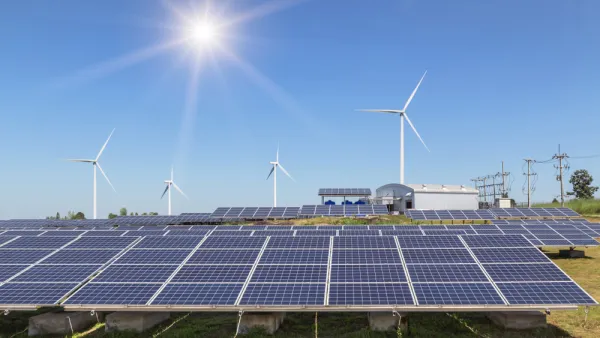
Building a Cleaner Future: Financing the Coal-to-Clean Transition
The Coal-to-Clean Initiative is an effort to fund the early retirement of coal plants in emerging markets, urging public-private collaboration to achieve a just energy transition that limits global warming and supports sustainable growth.
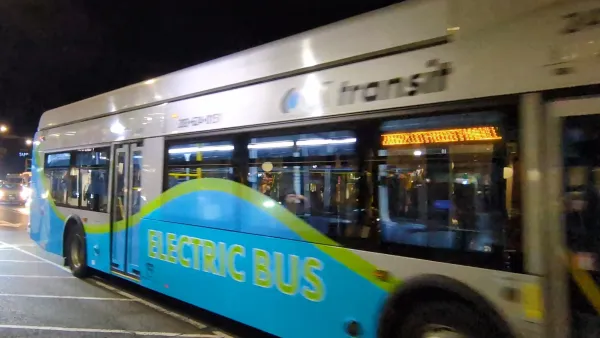
US Transit Fleets Have Bought Over 8,000 Zero-emission Buses
The number of zero-emission transit vehicles grew by 16 percent between 2024 and 2025.
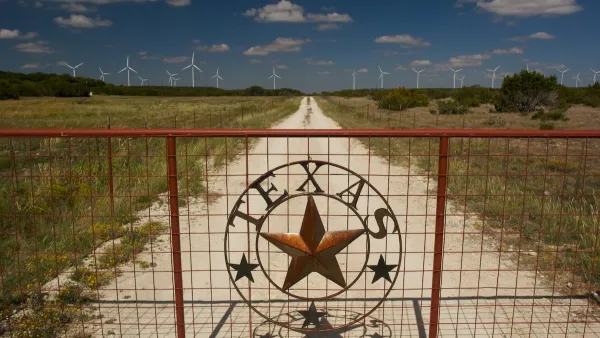
Texas Rural Communities Could Lose Billions From Renewable Energy Tax Credit Cuts
Texas produces more solar and wind energy than anywhere in America — and the tax revenue from it pays for rural schools, hospitals, law enforcement and more. The One Big Beautiful Bill threatens that.

Planetizen Federal Action Tracker
A weekly monitor of how Trump’s orders and actions are impacting planners and planning in America.

California plans to bury El Niño’s downpour
If the state plays its cards right, it may be able to store a billion acre-feet of El Niño’s water in aquifers.

Desperate measures: Advocates weigh draining Lake Powell to fill Colorado River
Draining the reservoir could reduce evaporation losses by a couple hundred thousand acre-feet.

In Texas, data centers are swallowing promised parkland
Residents who moved to Taylor, Texas for a rural community now have to contend with three data centers in their backyard.

How a Chicago-sized wind farm beat the odds and powered on
The project spanned five presidential administrations and a standoff with a U.S. military base.

MTA gives itself 30 days to transform pit into basketball court
The site has been under construction since 2022; the city originally estimated it would finish the court in 2024.

FREE Course: Walkable City 1: Why Walkability?
After describing his path towards focusing on walkability as the essence of good planning, Jeff Speck marches through his five principal reasons for making more walkable places.
Reinventing Malls: Planning Alchemy—Turning Gray Fields Into Gold
The course focuses on the opportunities and imperatives that shape reinvention of mall sites.

City of Rosemead
Rutgers University, Edward J. Bloustein School of Planning and Public Policy
One Hundred Miles
Hunter College, City University of New York (CUNY)
The Architects Foundation
University of Cincinnati Online
City of Cambridge
Montrose County
The Pocatello Development Authority