A newly restructured leadership promises to speed up the arduous construction process and start running trains in five to eight years.


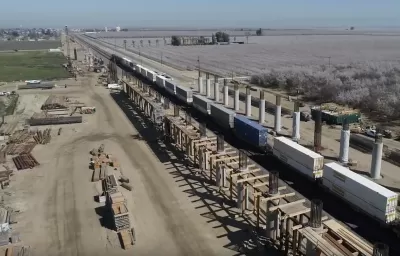
After a restructuring of the authority’s leadership, the California High-Speed Rail Authority (CHSRA) says it plans to begin running trains in five to eight years, reports Skip Descant in GovTech.
As Descant explains, “The 494-mile project to connect San Francisco and Los Angeles with trains traveling up to 220 mph has been hobbled by complications ranging from land acquisition to utility relocation to funding to political opposition, since voters approved a bond measure that paid for it in 2008.”
There are currently 171 miles of rail line under construction between Merced and Bakersfield in the Central Valley. According to the CHSRA, “Up to 24 stations will be constructed and the project will soon begin the phase of laying track and erecting the overhead catenary system of wires supplying electricity.”
The project will eventually connect to Palmdale, a desert community north of Los Angeles and a hub for the regional Metrolink train, in the south and to Gilroy, a town south of San Francisco with a Caltrain station, in the north.
FULL STORY: Restructured Calif. High-Speed Rail Is Poised to Lay Track

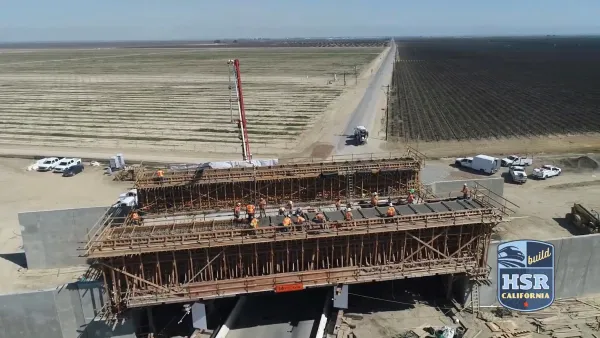
California High-Speed Rail Slashes $1.7B From 2026 Budget
The CHSRA plans to complete the Central Valley segment of the line and begin revenue service as soon as possible.
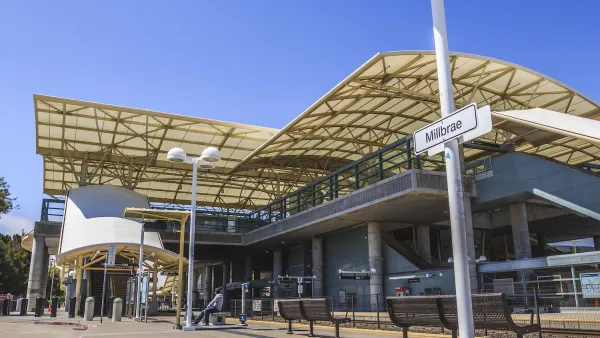
HSR Reaches Key Settlement in Northern California City
The state’s high-speed rail authority reached an agreement with Millbrae, a key city on the train’s proposed route to San Francisco.
California Assembly Continues to Debate High-Speed Rail
With a train-friendly administration in Washington, supporters of the project hope that state leaders will make a stronger commitment to funding the full project.

Planetizen Federal Action Tracker
A weekly monitor of how Trump’s orders and actions are impacting planners and planning in America.

The state-sanctioned urbicide of Austin
People don’t kill cities. Freeways do.

US to reduce Colorado River water deliveries to Mexico
A new Colorado Treaty amendment reduces Mexico’s Colorado River water allocation by 250,000 acre feet.

Mamdani overhauls NYC's Vision Zero plan with 100 new policy goals
The overhaul aims to reduce traffic deaths and make streets safer for pedestrians, cyclists and drivers through lower speed limits, new safety infrastructure and more.

Amtrak not solely to blame for New Jersey commuter rail's unreliability, report finds
A new study from the Garden State Initiative found that NJ Transit’s budget grew 20% across a 4 year period, but reliability declined significantly over the same period.

EPA erases limits on planet-warming pollution from power plants
Under Monday’s plan, power plants would still have some limits on how much mercury, arsenic and other contaminants they can emit.

FREE Course: Walkable City 1: Why Walkability?
After describing his path towards focusing on walkability as the essence of good planning, Jeff Speck marches through his five principal reasons for making more walkable places.
Reinventing Malls: Planning Alchemy—Turning Gray Fields Into Gold
The course focuses on the opportunities and imperatives that shape reinvention of mall sites.


Eagle County Government
Harvard University Graduate School of Design
Nashville Planning Department
The Architects Foundation
University of Cincinnati Online
The Pocatello Development Authority
The Urban Renewal Agency of the City of Pocatello
Journal of the American Planning Association