The practice creates dangerous conditions for pedestrians, cyclists, and anyone crossing in front of turning vehicles.


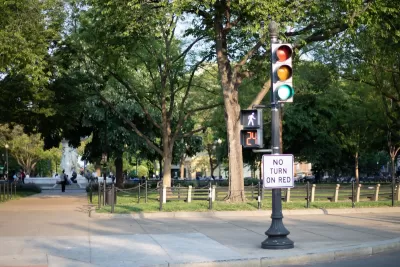
A December report from the Mineta Transportation Institute offers new evidence that allowing drivers to turn right on red lights makes roads more dangerous for pedestrians and people on bikes, reports Dan Zukowski in Smart Cities Dive.
Zukowski explains, “The study noted that ‘most drivers do not come to a complete stop and instead roll through’ the red light, creating a safety hazard for pedestrians in the crosswalk.”
The practice dates back to the 1970s, when a federal law permitted the practice as a fuel-saving measure during that era’s gas crisis. Throughout the United States, most cities allow turning right on red except where otherwise noted. But intersections with right turns on red see higher rates of collisions, while “The MTI research, quoting an Insurance Institute for Highway Safety study, noted that the odds of pedestrians dying were 89% greater in a right-turn collision involving pickup trucks and 63% greater with SUVs.”
As electric vehicles, which are heavier and accelerate at a faster rate than combustion-engine cars, become more common, the study concludes that banning right turns on red could be a key element in reducing traffic deaths and injuries.
Read the full story: Right turns on red puts pedestrians at risk, Mineta study says

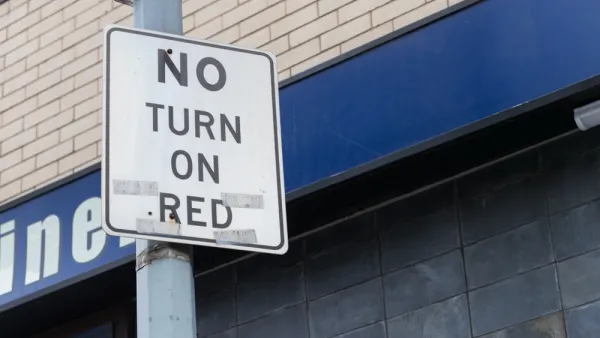
Banning Right Turns on Red: Lessons From Atlanta
How road safety activists passed a law that could make roads much safer.
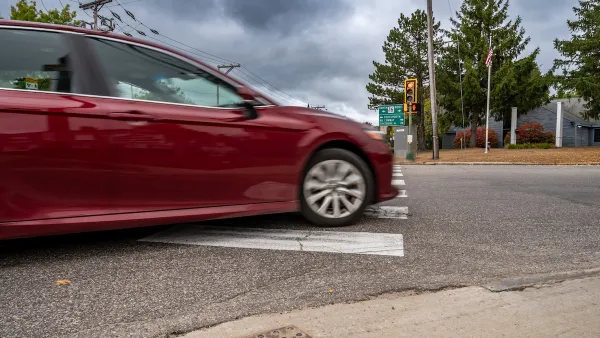
Banning Right Turns on Red Just One Step Toward Vision Zero
Experts caution that blanket bans on right turns on red make only a slight contribution to reducing fatal crashes, and other interventions are needed to bring down traffic fatalities.
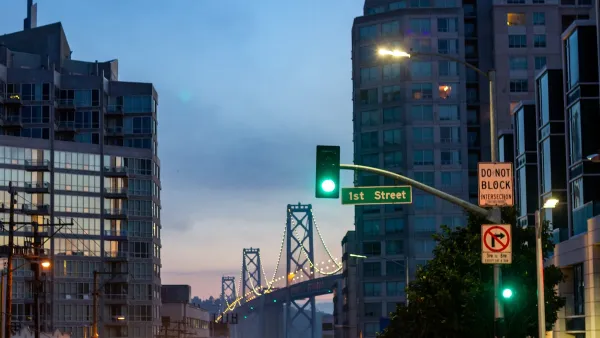
San Francisco Officials Call for Citywide Ban on Right Turns on Red
A proposal to prohibit turns on red at some downtown intersections prompted calls for a blanket ban for the entire city.

Planetizen Federal Action Tracker
A weekly monitor of how Trump’s orders and actions are impacting planners and planning in America.

California plans to bury El Niño’s downpour
If the state plays its cards right, it may be able to store a billion acre-feet of El Niño’s water in aquifers.

Chicago breaks ground on $3 billion megadevelopment
The new neighborhood, titled Foundry Park, will one day host 3,700 residences.

California High-Speed Rail Authority CEO resigns after $600,000 scandal
Under Ian Choudri, the authority used taxpayer dollars to fund first class flights and trips to nightclubs.

Want to study the Missouri River? Soon, you may need unanimous approval from 10 states
Legislation would require 10 governors’ permission to study or build projects moving water outside the basin.

Desperate measures: Advocates weigh draining Lake Powell to fill Colorado River
Draining the reservoir could reduce evaporation losses by a couple hundred thousand acre-feet.

FREE Course: Walkable City 1: Why Walkability?
After describing his path towards focusing on walkability as the essence of good planning, Jeff Speck marches through his five principal reasons for making more walkable places.
Reinventing Malls: Planning Alchemy—Turning Gray Fields Into Gold
The course focuses on the opportunities and imperatives that shape reinvention of mall sites.

City of Rosemead
Rutgers University, Edward J. Bloustein School of Planning and Public Policy
One Hundred Miles
Hunter College, City University of New York (CUNY)
The Architects Foundation
University of Cincinnati Online
City of Cambridge
Montrose County
The Pocatello Development Authority