The transit agency says it needs more state and federal support to meet its operating costs and avoid a growing budget gap.


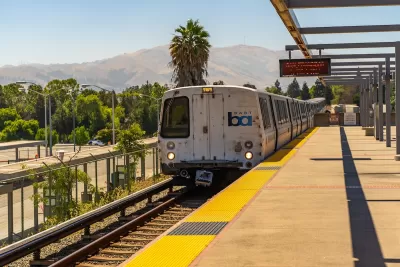
Bay Area Rapid Transit (BART) riders in the San Francisco Bay will see a 5.5 percent increase in fares starting on January 1, reports Aidin Vaziri for The San Francisco Chronicle.
According to Vaziri, “BART officials say the increase is essential to support ongoing operations and to address a growing budget deficit, which is projected to reach $35 million by 2026 and balloon to $385 million by 2027.” The agency continues to rely on fares as an important source of revenue, but that model has become largely unsustainable.
Like other transit leaders around the country, BART officials are calling on state and federal governments to support public transit with more dedicated funding. “As part of its strategy to balance the budget, BART is also focusing on cost-saving measures, such as more efficient scheduling and reduced train sizes to lower operational expenses.”
Read the full story: BART announces another fare hike as agency struggles with budget woes
California Revives $750M Loan to Save Bay Area Transit
The state approved a $750 million loan as a stopgap measure to fund regional transit agencies until a 2026 ballot measure that could bring more permanent funding.

California Rejects Loan to Save Bay Area Transit
The state’s Department of Finance wants to extend negotiations about the loan, making it unlikely transit agencies will receive any assistance before the end of the year.

BART Closes $35 Million Deficit
Cost control and revenue generation measures prevented service cuts.

Planetizen Federal Action Tracker
A weekly monitor of how Trump’s orders and actions are impacting planners and planning in America.

California plans to bury El Niño’s downpour
If the state plays its cards right, it may be able to store a billion acre-feet of El Niño’s water in aquifers.

Desperate measures: Advocates weigh draining Lake Powell to fill Colorado River
Draining the reservoir could reduce evaporation losses by a couple hundred thousand acre-feet.

In Texas, data centers are swallowing promised parkland
Residents who moved to Taylor, Texas for a rural community now have to contend with three data centers in their backyard.

How a Chicago-sized wind farm beat the odds and powered on
The project spanned five presidential administrations and a standoff with a U.S. military base.

MTA gives itself 30 days to transform pit into basketball court
The site has been under construction since 2022; the city originally estimated it would finish the court in 2024.

FREE Course: Walkable City 1: Why Walkability?
After describing his path towards focusing on walkability as the essence of good planning, Jeff Speck marches through his five principal reasons for making more walkable places.
Reinventing Malls: Planning Alchemy—Turning Gray Fields Into Gold
The course focuses on the opportunities and imperatives that shape reinvention of mall sites.

City of Rosemead
Rutgers University, Edward J. Bloustein School of Planning and Public Policy
One Hundred Miles
Hunter College, City University of New York (CUNY)
The Architects Foundation
University of Cincinnati Online
City of Cambridge
Montrose County
The Pocatello Development Authority