City officials say funding for dedicated bus lanes could take years, but other improvements could speed up bus service.


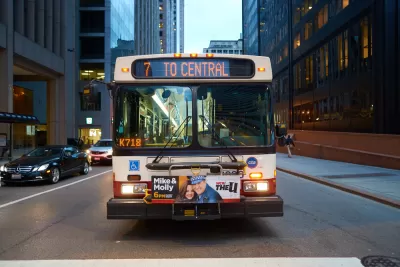
Chicago City Council members say the city may not see true bus rapid transit (BRT) anytime soon, but “Instead, officials with the CTA and the Chicago Department of Transportation told the Committee on Pedestrian and Public Safety they are also exploring smaller efforts to improve bus travel, such as traffic signals that wait for buses to pass and ways for buses to skip ahead of traffic.”
In an article for the Chicago Sun-Times, David Struett writes, “This is a “dual-track” mindset that the CTA has recently taken up to try to improve bus travel as the agency waits for longer-term federal funding for bigger projects, said Molly Poppe, CTA’s chief of planning and innovation.”
Dedicated bus lanes in some parts of the city sped up bus arrival times by 12 to 21 percent. The city is studying the potential for more bus improvements via its Better Streets for Buses project.
“One improvement is traffic signal priority, a technology that delays a green light from turning red if it senses a CTA bus nearby is running late. The city has installed this at 130 intersections, and plans to install 49 more in 2025, said Vig Krishnamurthy, managing deputy commissioner at CDOT.”
FULL STORY: Bus rapid transit a possibility in Chicago but still a long way off, transit officials say

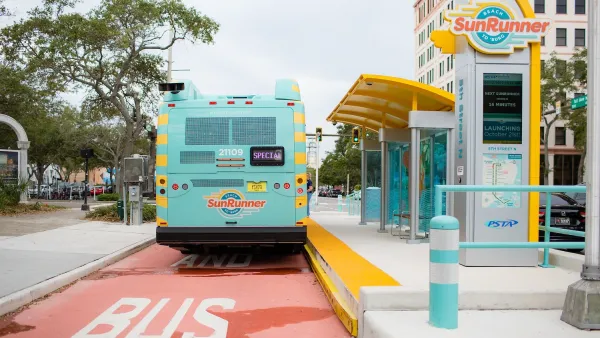
Lawsuit Claims Florida Bus Lane Removal was Illegal
The state cites an increase in crashes and congestion as reasons for eliminating a dedicated bus lane on the SunRunner BRT line, but city data tells a different story.
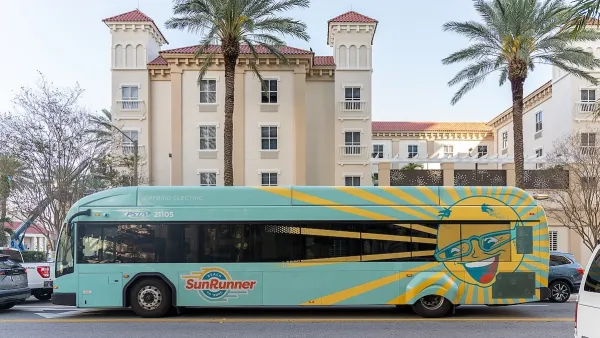
Florida DOT Orders Removal of St. Pete Bus Lane
The state says a popular BRT line has increased crashes and traffic on a state-owned portion of its corridor, prompting it to call for its reversal.

Miami to Launch America's First Fully Electric Bus Rapid Transit Line
The project, led by Miami-Dade County, will link Dadeland South to Florida City via a 20-mile dedicated lane.

Planetizen Federal Action Tracker
A weekly monitor of how Trump’s orders and actions are impacting planners and planning in America.

The state-sanctioned urbicide of Austin
People don’t kill cities. Freeways do.

US to reduce Colorado River water deliveries to Mexico
A new Colorado Treaty amendment reduces Mexico’s Colorado River water allocation by 250,000 acre feet.

5 New England states march closer to 800 megawatt wind energy project
Securing federal approval for the project may be complicated under the Trump administration, which has historically been hostile towards domestic wind power.

Baltimore to break ground on $50 million Transit Priority Project
The project will bring faster bus trips, safer streets and better bike connections to Baltimore.

Airbnb launches $250 million 'last-dollar financing' housing accelerator, makes first investment in Austin
The company will put $6.4 million towards affordable housing development in Texas’ capital.

FREE Course: Walkable City 1: Why Walkability?
After describing his path towards focusing on walkability as the essence of good planning, Jeff Speck marches through his five principal reasons for making more walkable places.
Reinventing Malls: Planning Alchemy—Turning Gray Fields Into Gold
The course focuses on the opportunities and imperatives that shape reinvention of mall sites.

Eagle County Government
Harvard University Graduate School of Design
Nashville Planning Department
The Architects Foundation
University of Cincinnati Online
The Pocatello Development Authority
The Urban Renewal Agency of the City of Pocatello
Journal of the American Planning Association