The proposed Dorchester Greenway would create a new linear park above part of the Red Line subway.


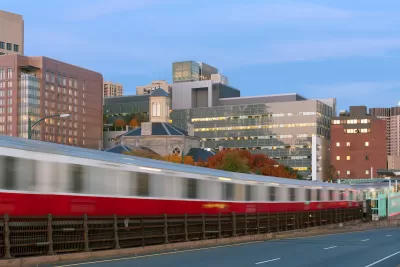
A proposed greenway would cap a 0.75-mile subterranean segment of Boston’s Red Line subway with a linear park, reports Daniel Roche in The Architect’s Newspaper. “With $300,000 in funding from the MassTrails program, a state initiative, and an additional $368,000 from the city of Boston; officials, community leaders, and designers are gearing up to build a new pathway for walkers and bikers, dubbed The Dorchester Greenway.”
According to Roche, “Today, the stretch between Fields Corner Station and Ashmont Station is below grade, topped by a derelict asphalt carpet. For years, community activists have sought to build a park on the land currently owned by the Massachusetts Bay Transportation Authority (MBTA).” Local advocates say the greenway would provide new public green space and stitch the neighborhood back together. Cap parks are becoming an increasingly popular way to utilize space above active or defunct freeways or subway lines, although some projects, like one in Denver, have triggered gentrification and displacement concerns.
FULL STORY: The Dorchester Greenway, a speculative linear park, may soon be built in Boston over the Red Line

I Help Plan Cap Parks; Here’s What Austin Can Learn from Other Cities
How freeway capping projects can literally and metaphorically bridge urban divides.
Austin Officials Pump the Brakes on I-35 ‘Cap & Stitch’ Project
The city approved a plan to build cap parks over parts of I-35 less than a year ago.
USDOT Denies Portland Freeway Expansion Grant
The agency declined the Oregon Department of Transportation’s request for $750 million to fund the I-5 Rose Quarter Improvement Project.

Planetizen Federal Action Tracker
A weekly monitor of how Trump’s orders and actions are impacting planners and planning in America.

The state-sanctioned urbicide of Austin
People don’t kill cities. Freeways do.

US to reduce Colorado River water deliveries to Mexico
A new Colorado Treaty amendment reduces Mexico’s Colorado River water allocation by 250,000 acre feet.

Mamdani overhauls NYC's Vision Zero plan with 100 new policy goals
The overhaul aims to reduce traffic deaths and make streets safer for pedestrians, cyclists and drivers through lower speed limits, new safety infrastructure and more.

Amtrak not solely to blame for New Jersey commuter rail's unreliability, report finds
A new study from the Garden State Initiative found that NJ Transit’s budget grew 20% across a 4 year period, but reliability declined significantly over the same period.

EPA erases limits on planet-warming pollution from power plants
Under Monday’s plan, power plants would still have some limits on how much mercury, arsenic and other contaminants they can emit.

FREE Course: Walkable City 1: Why Walkability?
After describing his path towards focusing on walkability as the essence of good planning, Jeff Speck marches through his five principal reasons for making more walkable places.
Reinventing Malls: Planning Alchemy—Turning Gray Fields Into Gold
The course focuses on the opportunities and imperatives that shape reinvention of mall sites.

Eagle County Government
Harvard University Graduate School of Design
Nashville Planning Department
The Architects Foundation
University of Cincinnati Online
The Pocatello Development Authority
The Urban Renewal Agency of the City of Pocatello
Journal of the American Planning Association