The City of Santa Monica took a key step forward in the process of closing the airport, approving an agreement with Sasaki Inc. to assess existing site conditions, gather public input, and propose options for turning the airport into a park.



In a major move towards closing the Santa Monica Airport, the Santa Monica City Council recently approved an agreement with Sasaki Inc. to evaluate current site conditions, gather public input, and propose future options for the airport land centering around the concept of a “Great Park”. Sasaki, Inc. is an interdisciplinary architecture, planning, landscape, and design firm.
The city plans to initiate the "Airport Conversion Planning Project" with Sasaki in early 2024. Sasaki will lead research and public outreach efforts in the following five distinct phases, aiming to bring forth a preferred scenario to City Council at the end of 2025.
- Phase 1: Charting the Course – Project Kick-off, Alignment, Document Review, Future Needs and Desires (3 months)
- Phase 2: Discovering the Place and Setting the Stage – Existing Conditions Analysis, Guiding Principles (5 months)
- Phase 3: Defining the Future of Place - Scenario Testing and Plans (8 months)
- Phase 4: The Path Ahead – Potential Implementation Planning (3 months)
- Phase 5: Preferred Scenario Plan Vision Book (2 months)
Throughout each phase, Sasaki, in coordination with city staff, will hold over 60 meetings and listening sessions with community members, city boards and commissions and the City Council in various formats.
The 227-acre airport property represents almost five percent of the city's total land area. The city has obtained authorization from the Federal Aviation Administration to close the airport for aviation uses after December 31, 2028, and passed a resolution in 2017 codifying that plan. The property is subject to voter-approved Measure LC, which restricts development on the airport property to only allow parks, public open spaces and public recreational facilities and the maintenance and replacement of existing cultural, arts and educational uses.
FULL STORY: Council Advances Santa Monica Airport Closure Process with Sasaki Inc. Agreement


Santa Monica residents argue historic airport is 'critical' for public safety
Some locals are asking the city to reconsider its planned closure of the airport in late 2028.

Judge orders Waymo to stop using 2 Santa Monica charging stations after noise complaints
Neighbors have asked the city to ban the company from using charging stations in residential areas between 11pm and 6am.
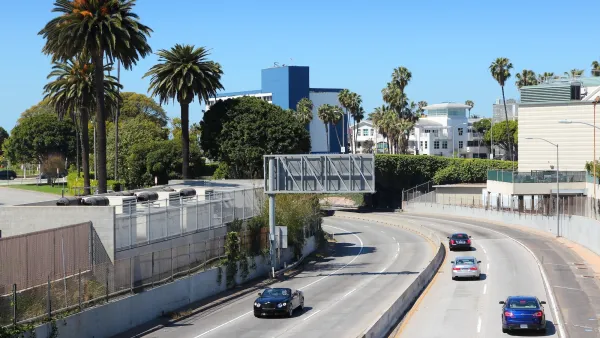
Santa Monica gets $2M grant to study I-10 freeway cap
City officials want to explore capping or even removing a portion of the freeway in the Pico neighborhood.

Planetizen Federal Action Tracker
A weekly monitor of how Trump’s orders and actions are impacting planners and planning in America.

The state-sanctioned urbicide of Austin
People don’t kill cities. Freeways do.

US to reduce Colorado River water deliveries to Mexico
A new Colorado Treaty amendment reduces Mexico’s Colorado River water allocation by 250,000 acre feet.

5 New England states march closer to 800 megawatt wind energy project
Securing federal approval for the project may be complicated under the Trump administration, which has historically been hostile towards domestic wind power.

Baltimore to break ground on $50 million Transit Priority Project
The project will bring faster bus trips, safer streets and better bike connections to Baltimore.

Airbnb launches $250 million 'last-dollar financing' housing accelerator, makes first investment in Austin
The company will put $6.4 million towards affordable housing development in Texas’ capital.

FREE Course: Walkable City 1: Why Walkability?
After describing his path towards focusing on walkability as the essence of good planning, Jeff Speck marches through his five principal reasons for making more walkable places.
Reinventing Malls: Planning Alchemy—Turning Gray Fields Into Gold
The course focuses on the opportunities and imperatives that shape reinvention of mall sites.

Eagle County Government
Harvard University Graduate School of Design
Nashville Planning Department
The Architects Foundation
University of Cincinnati Online
The Pocatello Development Authority
The Urban Renewal Agency of the City of Pocatello
Journal of the American Planning Association