Data from a Los Angeles car share program showed its impact on underserved communities was ‘limited by its small footprint.’


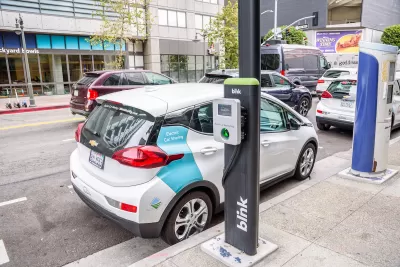
A new report assesses the potential of the BlueLA car share program to improve transportation equity in Los Angeles. As Gersh Kuntzman explains in Streetsblog USA, the report notes that low-income residents gain improved transportation access only when programs are heavily subsidized and have broad coverage areas.
“There's no question that car-share has shown potential in helping urban areas reduce automobile ownership and lower vehicle miles traveled, as well as increasing walking and public transit use. But other studies have shown that urban car-share members are disproportionately white, even when vehicles are located in neighborhoods with many disadvantaged residents.”
The BlueLA program aimed to provide service in underserved areas and offer low rates, but the study notes that “during the study period, BlueLA stations ‘only served a small portion of the city of Los Angeles,’ the report said, reducing transportation access for people who don't own cars, but would have liked to have used BlueLA.”
Kuntzman gives examples from other cities that are working to expand access to car share services. “The Philadelphia Housing Authority has just inked a deal — thanks to a federal Housing and Urban Development job program grant — that will bring two Zipcars to each of four housing projects,” and New York City is providing public housing residents with free Zipcar memberships. City officials hope car share can improve mobility and help residents avoid the burdens of car ownership.
Read the full story: To Improve Equity, Car-Share Needs Subsidies, Large Coverage Area: Report
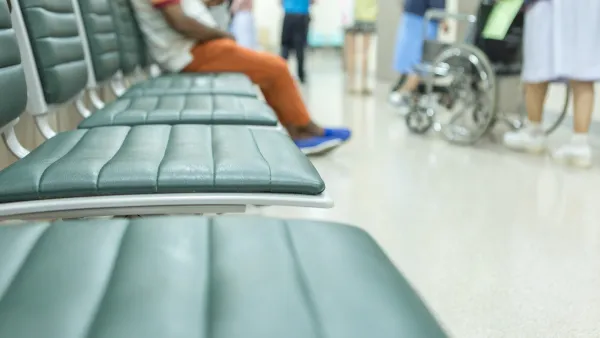
Linking Transportation Access and Public Health
Millions of Americans miss medical care and other important day-to-day appointments due to a lack of access to reliable transportation.
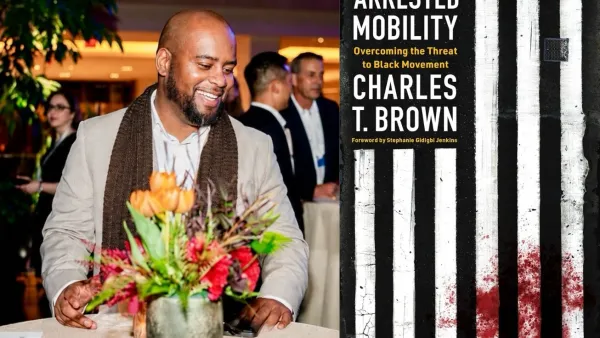
'Arrested mobility' and the fight for Black movement
Author Charles T. Brown explains how his experience growing up in rural Mississippi shaped his worldview and his current work for equitable transportation.
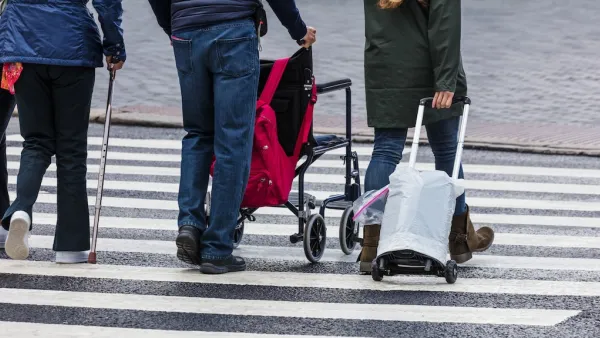
‘Week Without Driving’ Highlights Needs of Non-Drivers
The event encourages public officials to use their local public transit and engage with the people who rely on it every day.

Planetizen Federal Action Tracker
A weekly monitor of how Trump’s orders and actions are impacting planners and planning in America.

California plans to bury El Niño’s downpour
If the state plays its cards right, it may be able to store a billion acre-feet of El Niño’s water in aquifers.

Desperate measures: Advocates weigh draining Lake Powell to fill Colorado River
Draining the reservoir could reduce evaporation losses by a couple hundred thousand acre-feet.

Mamdani’s pied-à-terre tax survives legal challenge
A panel of judges found that the plaintiffs failed to demonstrate injury as a result of New York City's implementation of the tax.

Eastern Nebraska is running out of electricity
Data centers and electrification are straining eastern Nebraska’s grid, throttling economic development.

Seattle passes record-breaking transit services expansion
Proposition 1 will double the city’s transit tax to add 95,000 more bus trips and preserve 180,000 bus trips annually.

FREE Course: Walkable City 1: Why Walkability?
After describing his path towards focusing on walkability as the essence of good planning, Jeff Speck marches through his five principal reasons for making more walkable places.
Reinventing Malls: Planning Alchemy—Turning Gray Fields Into Gold
The course focuses on the opportunities and imperatives that shape reinvention of mall sites.

City of Rosemead
Rutgers University, Edward J. Bloustein School of Planning and Public Policy
One Hundred Miles
University of Michigan School for Environment and Sustainability (SEAS)
Hunter College, City University of New York (CUNY)
The Architects Foundation
City of Cambridge
Montrose County
The Pocatello Development Authority