Caltrans moved a segment of the state’s celebrated Highway 1 inland by 400 feet to avoid erosion caused by sea level rise.


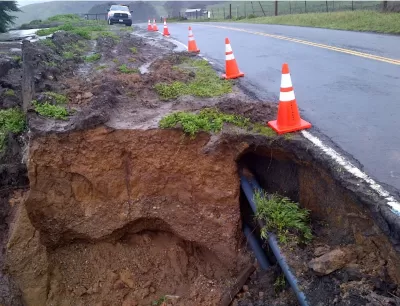
In a first for the California Department of Transportation (Caltrans), the agency moved a Sonoma County highway segment 400 feet inland to protect it from coastal erosion, reports Maggie Fusek in Patch Petaluma. The Gleason Beach Highway Realignment “involved building 4,000 feet of new highway, including an 810-foot, two-lane bridge with a separated pedestrian walkway and 12-foot shoulders to accommodate bicycle travel.”
According to State Sen. Mike McGuire, “This specific segment of Highway 1 has been especially challenging, constantly being undermined by coastal erosion near Scotty Creek.” The project removed a culvert, letting Scotty Creek flow “unimpeded to the ocean, allowing coho salmon and steelhead to swim upstream again to spawn,” and reconnected a wetland previously divided by the old road. “While the advancing ocean was the reason for this project, it would be foolish to imply that nature is our adversary,” said Caltrans Bay Area Director Dina El Tawansy.
FULL STORY: CA Highway 1 Moved 400 Feet, Marks 1st Sea-Level Rise Caltrans Project

Atlantic Coast Infrastructure at Risk from Sea Level Rise
New research reveals that some coastal areas are sinking by as much as 5 millimeters per year, which could threaten key infrastructure.
State Leaders Warn of Risks to Southern California Rail Corridor
Coastal erosion and rising sea levels threaten one of the nation’s most scenic—and strategically important—rail corridors.

California State Law Calls on Coastal Regions to Create Resiliency Plans
Cities and counties at risk of flooding and erosion from sea level rise can access state funding to implement coastal resiliency plans.

The state-sanctioned urbicide of Austin
People don’t kill cities. Freeways do.

US to reduce Colorado River water deliveries to Mexico
A new Colorado Treaty amendment reduces Mexico’s Colorado River water allocation by 250,000 acre feet.

New Jersey’s second-largest city bans standalone data centers
Jersey City will continue to allow co-location facilities, such as those meant for research institutions that store their own data.

Amtrak not solely to blame for New Jersey commuter rail's unreliability, report finds
A new study from the Garden State Initiative found that NJ Transit’s budget grew 20% across a 4 year period, but reliability declined significantly over the same period.

EPA erases limits on planet-warming pollution from power plants
Under Monday’s plan, power plants would still have some limits on how much mercury, arsenic and other contaminants they can emit.

Phoenix announces new on-demand transit service, more frequent RAPID buses
Both new services will launch in October, and are part of Phoenix's Project Effective Access Solutions for Easing Congestion.

FREE Course: Walkable City 1: Why Walkability?
After describing his path towards focusing on walkability as the essence of good planning, Jeff Speck marches through his five principal reasons for making more walkable places.
Reinventing Malls: Planning Alchemy—Turning Gray Fields Into Gold
The course focuses on the opportunities and imperatives that shape reinvention of mall sites.

Eagle County Government
Harvard University Graduate School of Design
Nashville Planning Department
The Architects Foundation
University of Cincinnati Online
The Pocatello Development Authority
The Urban Renewal Agency of the City of Pocatello
Journal of the American Planning Association