One author calls on planners to challenge assumptions that exclude people with mobility challenges and other disabilities.


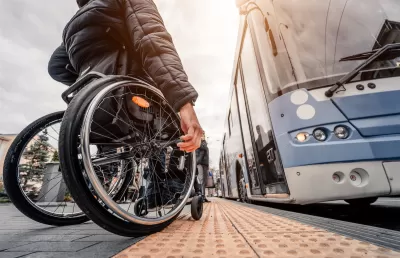
In a piece in The Conversation, Ronald Norman Buliung presents a new take on the 15-minute city, a planning concept that promotes walkable, compact neighborhoods. For Buliung, the approach “relies on ableist assumptions.”
“The 15-minute city relies on residents’ abilities to walk and bike. This raises several questions: What if a resident’s body doesn’t walk or bike in what is considered a normative sense? What if someone uses a mobility device or moves at a slower pace? What if a resident requires public or school transportation vehicles to be adapted? ”
Buliung argues that the existing regulatory frameworks governing accessibility “reveal an emphasis on physical disability and serious limitations in terms of revision and enforcement.” Thus, “It would therefore be foolish to rely on such a relatively inflexibly narrow regulatory environment to make up for any ableist limitations of planning concepts used to shape sustainable, inclusive urban futures.”
Noting that disability is often an afterthought in planning, Buliung suggests that, from the beginning of the planning process, planners should “consider what cities or neighbourhoods might look like when designed with disability in mind.”
Read the full story: The 15-minute city is a popular planning approach, but relies on ableist assumptions


Zoning for Good
A new book highlights the power of zoning to change communities for the better.

When ‘Prioritizing All Modes’ Is a Lie
In many cases, it’s impossible to prioritize the safety of pedestrians and other vulnerable road users without sacrificing some speed.
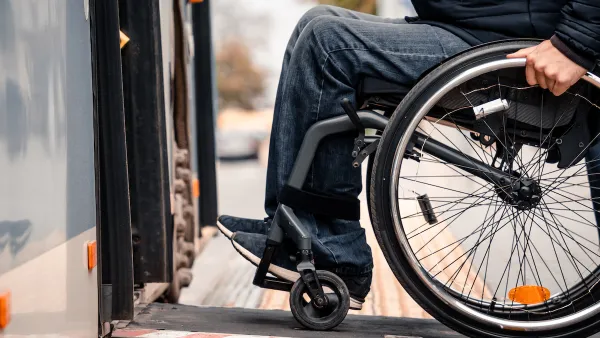
How to Improve Transit Accessibility
Over 13 million Americans face mobility challenges that limit their travel experience.

Planetizen Federal Action Tracker
A weekly monitor of how Trump’s orders and actions are impacting planners and planning in America.

Amtrak, CN end decades-long dispute with eight-year agreement
The new operating agreement establishes an updated framework for the companies to work together, including processes to resolve disputes.

Northwest rail fans eager for Sept. 30 debut of Amtrak’s Airo fleet
Get ready for that new train smell and more seats. But they won’t go faster or run more frequently on the Cascades route in Washington and Oregon.

As El Niño approaches, Newsom vetos bill aimed at protecting California levees from flooding
Gov. Gavin Newsom said the state’s allocated $170 million was enough funding; State experts estimate it will cost $3.3 billion to repair the California Delta's levees.

Boston sues Trump administration over revoked infrastructure grant
The Trump administration withdrew the infrastructure grant because less than 1% of the money would go to electric vehicle charging infrastructure.

NYC to turn city-owned property into thousands of homes
The city has scheduled a public hearing regarding the development for October.

FREE Course: Walkable City 1: Why Walkability?
After describing his path towards focusing on walkability as the essence of good planning, Jeff Speck marches through his five principal reasons for making more walkable places.
Reinventing Malls: Planning Alchemy—Turning Gray Fields Into Gold
The course focuses on the opportunities and imperatives that shape reinvention of mall sites.

City of Thousand Oaks
City of Wisconsin Rapids
Harvard University Graduate School of Design
The Architects Foundation
University of Cincinnati Online
The Pocatello Development Authority
The Urban Renewal Agency of the City of Pocatello