The city’s fire department has asked for a moratorium on new traffic circles, installed as a traffic calming mechanism.


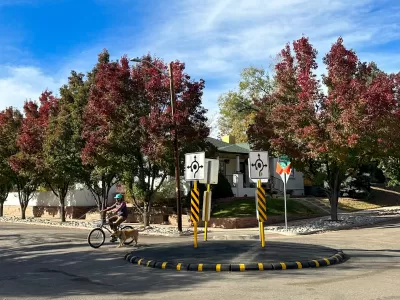
The Denver Fire Department has asked the city to stop the installation of new traffic circles in the city, citing safety concerns, reports Mark Samuelson in The Denver Gazette. The traffic circles are designed to slow traffic and improve safety as part of the city's Neighborhood Bikeway program, and are a commonly used device in most of the world.
“Neighbors in the area along 7th Avenue noted ongoing tests by fire trucks negotiating the tight turns of the small roundabouts, where residents have reported some crashes that followed their installation this summer,” Samuelson writes.
Denver fire captain J.D. Chism told the Gazette that there is now a ‘moratorium’ on installing new traffic circles, but City transportation spokesperson Nancy Kuhn “would not confirm that her agency is working under a moratorium regarding the devices.” Instead, Kuhn said the Department of Transportation and Infrastructure “will continue to work on refining them, working with DFD.”
FULL STORY: Denver Fire places a moratorium on new traffic circles

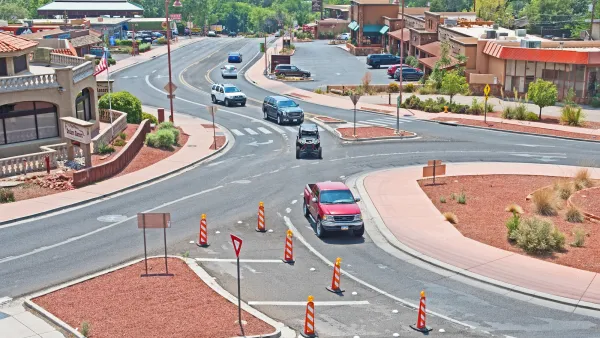
Study: Roundabouts are Primarily in Wealthier Neighborhoods
A North Carolina study sheds light on inequities in road safety interventions.
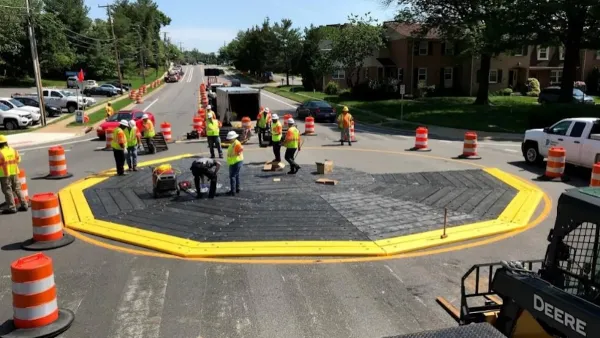
‘Modular Roundabouts’ Offer Quick-Build Traffic Safety Solution
The prefabricated roundabouts can be installed more quickly and at a much lower cost than traditional concrete traffic circles.
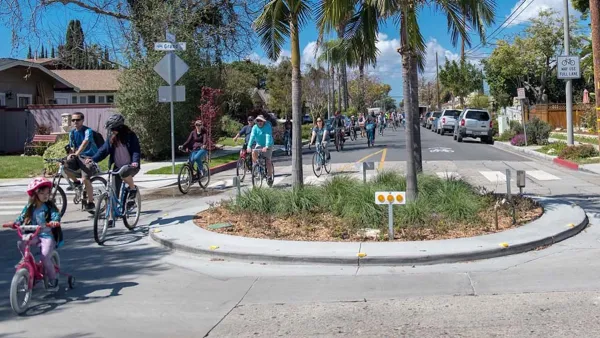
Long Beach Has Installed Nearly 100 Traffic Circles
They range from large traffic circles that reduce congestion to small neighborhood roundabouts designed to slow local traffic.

Planetizen Federal Action Tracker
A weekly monitor of how Trump’s orders and actions are impacting planners and planning in America.

The state-sanctioned urbicide of Austin
People don’t kill cities. Freeways do.

US to reduce Colorado River water deliveries to Mexico
A new Colorado Treaty amendment reduces Mexico’s Colorado River water allocation by 250,000 acre feet.

5 New England states march closer to 800 megawatt wind energy project
Securing federal approval for the project may be complicated under the Trump administration, which has historically been hostile towards domestic wind power.

Baltimore to break ground on $50 million Transit Priority Project
The project will bring faster bus trips, safer streets and better bike connections to Baltimore.

Airbnb launches $250 million 'last-dollar financing' housing accelerator, makes first investment in Austin
The company will put $6.4 million towards affordable housing development in Texas’ capital.

FREE Course: Walkable City 1: Why Walkability?
After describing his path towards focusing on walkability as the essence of good planning, Jeff Speck marches through his five principal reasons for making more walkable places.
Reinventing Malls: Planning Alchemy—Turning Gray Fields Into Gold
The course focuses on the opportunities and imperatives that shape reinvention of mall sites.

Eagle County Government
Harvard University Graduate School of Design
Nashville Planning Department
The Architects Foundation
University of Cincinnati Online
The Pocatello Development Authority
The Urban Renewal Agency of the City of Pocatello
Journal of the American Planning Association