The new rules could help bridge the gaps in accessibility infrastructure and ADA compliance, making roads and sidewalks safer for everyone.


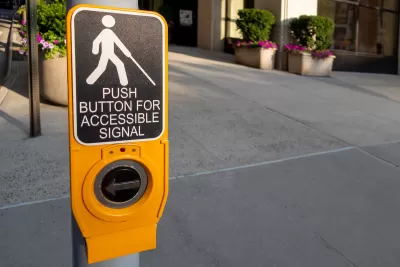
Writing in Strong Towns, Ben Abramson asserts that newly approved Americans with Disabilities Act (ADA) and Architectural Barriers Act (ABA) Public Right-of-Way Accessibility Guidelines (PROWAG) “promise to make American towns and cities safer and more predictable for users of all abilities.”
The new guidelines “address access to sidewalks and streets, crosswalks, curb ramps, pedestrian signals, on-street parking, and other components of public rights-of-way,” Abramson adds.
The new PROWAG adds accessibility requirements to pedestrian access routes such as slope, calls for alternate access routes in construction areas, and mandates curb cuts and detectable warning surfaces at crosswalks. It also requires accessible pedestrian signals, “which have audible and vibrotactile features indicating the walk interval so that a pedestrian who is blind or has low vision will know when to cross the street.”
The guidelines also address accessibility at transit stops and accessible parking spaces in neighborhoods with street parking.
For Strong Towns director of community action Edward Erfurt, “the level of detail in the new guidelines is a game changer” that will bring new best practices to cities that have lagged behind in implementing accessibility improvements. “This specificity, and the legal requirement that planners and engineers adhere to the guidelines, promises to bring improvements that will make everyone in American cities safer.”
FULL STORY: New PROWAG Guidelines a Major Advance for ADA (and All Pedestrians)


Understanding Accessibility in the Public Right-of-Way
A ‘best practices’ manual guides accessibility on streets and sidewalks, but remains legally unenforceable.
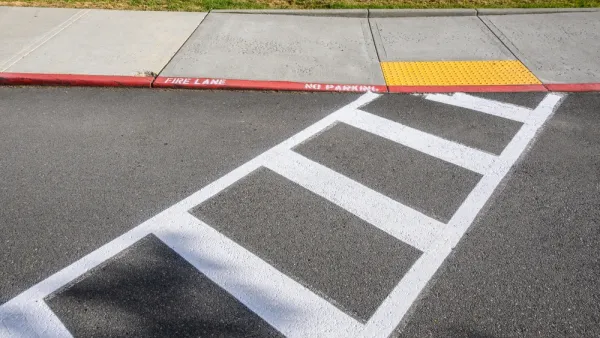
Following Lawsuit, Philadelphia to Add or Fix 10,000 Curb Cuts
Disability rights advocates won a settlement that directs the city to improve accessibility on its public roads over the next 15 years.
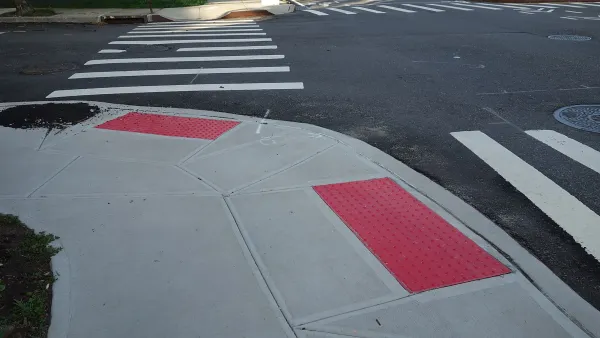
Federal Government to Enforce Accessibility Guidelines
Local agencies will soon be tasked with adhering to federal right-of-way accessibility rules: comprehensive guidelines for accessible streets and sidewalks.

Planetizen Federal Action Tracker
A weekly monitor of how Trump’s orders and actions are impacting planners and planning in America.

The state-sanctioned urbicide of Austin
People don’t kill cities. Freeways do.

US to reduce Colorado River water deliveries to Mexico
A new Colorado Treaty amendment reduces Mexico’s Colorado River water allocation by 250,000 acre feet.

5 New England states march closer to 800 megawatt wind energy project
Securing federal approval for the project may be complicated under the Trump administration, which has historically been hostile towards domestic wind power.

Baltimore to break ground on $50 million Transit Priority Project
The project will bring faster bus trips, safer streets and better bike connections to Baltimore.

Airbnb launches $250 million 'last-dollar financing' housing accelerator, makes first investment in Austin
The company will put $6.4 million towards affordable housing development in Texas’ capital.

FREE Course: Walkable City 1: Why Walkability?
After describing his path towards focusing on walkability as the essence of good planning, Jeff Speck marches through his five principal reasons for making more walkable places.
Reinventing Malls: Planning Alchemy—Turning Gray Fields Into Gold
The course focuses on the opportunities and imperatives that shape reinvention of mall sites.

Eagle County Government
Harvard University Graduate School of Design
Nashville Planning Department
The Architects Foundation
University of Cincinnati Online
The Pocatello Development Authority
The Urban Renewal Agency of the City of Pocatello
Journal of the American Planning Association