Five projects are moving the United States forward on so-called “higher-speed” rail.


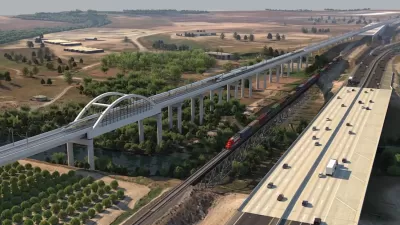
While the United States lags considerably behind other developed and developing countries on the construction of high-speed rail, several recent projects, in Florida and between Illinois and Missouri, have made progress on “higher-speed” rail—trains that goes fast, just not quite fast enough to fit the industry’s definition of high-speed rail. (For the record, the Congressional Research Service defines “Higher Speed Rail” as rail services with speeds up to 150 mph.)
A paywalled article by Luz Lazo for the Washington Post updates the progress on five projects underway around the United States to bring new speeds and new routes to the United States’ intercity rail offerings.
The five projects included in the article, with notable facts, funding details, remaining challenges, and timelines provided for each of the projects:
- Amtrak’s Acela high(er)-speed trains will reach 160 mph at various points between Boston and Washington, D.C.
- Brightline West is an electrified rail line that would reach speeds of 186 mph between Rancho Cucamonga, in California, and Las Vegas, in Nevada. Brightline West gained a key federal approval in July 2023.
- California High-Speed Rail is under construction and attracting constant controversy. When and if the project is completed, electrified trains would reach planned speeds of 220 mph between San Francisco and Los Angeles. Later extensions would reach to Sacramento and San Diego.
- Texas High-Speed Rail is battling legal controversy over eminent domain, rising costs, and political opposition, but recently gained new momentum with the possibility of a public-private partnership between Amtrak and Texas Central. The rail line is planned for 200 mph speeds between Dallas and Houston.
- Cascadia High-Speed Rail is actually an international proposition—potentially linking cities in the Pacific Northwest beyond the U.S. Canadian border in Vancouver, British Columbia. According to Luz, project planners aim for Cascadia High-Speed Rail trains to reach 250 mph.
Read the full story: The 5 higher-speed rail projects taking shape in the U.S.

Federal Grants for Passenger Rail Top $8 Billion
The Federal Railroad Administration announced the grants to dozens of projects for expanding or building new rail corridors.
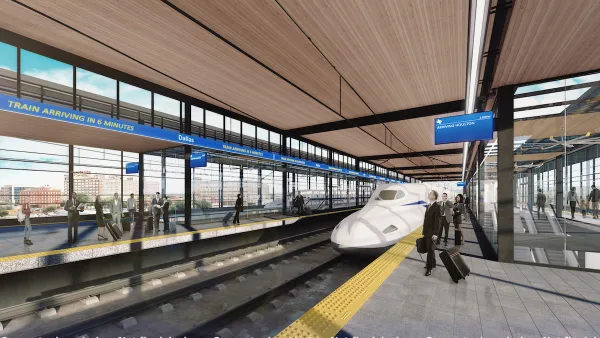
Amtrak Exploring Partnership for Central Texas Bullet Train
A privately funded high-speed rail line could link Houston and Dallas.
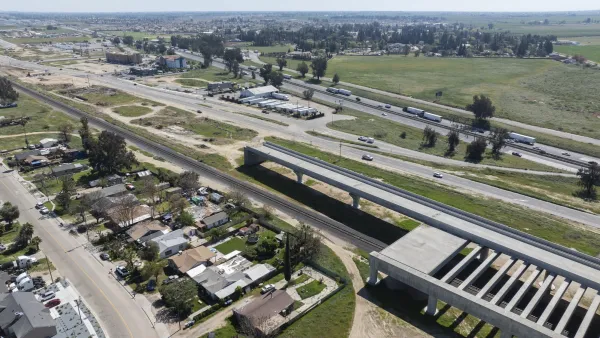
California rail builders sign MOU advancing statewide high-speed network
The agreement aims to create an interconnected high-speed rail network and bring down the cost of construction.

Planetizen Federal Action Tracker
A weekly monitor of how Trump’s orders and actions are impacting planners and planning in America.

Amtrak, CN end decades-long dispute with eight-year agreement
The new operating agreement establishes an updated framework for the companies to work together, including processes to resolve disputes.

Northwest rail fans eager for Sept. 30 debut of Amtrak’s Airo fleet
Get ready for that new train smell and more seats. But they won’t go faster or run more frequently on the Cascades route in Washington and Oregon.

Trump administration unlawfully slashed $7 billion in clean energy grants, judge rules
The Environmental Protection Agency ended the Solar For All program, which provided the grants, after President Donald Trump’s inauguration.

Record-breaking wildlife overpass in Colorado brings 91% reduction in animal collisions
Prior to the overpass, vehicles were hitting one deer per day on Colorado’s Interstate 25.

California lawmakers approve just 5% of much-needed LA28 transportation funding
State legislators appear just as unwilling as Trump to pay for Olympics-related transportation projects.

FREE Course: Walkable City 1: Why Walkability?
After describing his path towards focusing on walkability as the essence of good planning, Jeff Speck marches through his five principal reasons for making more walkable places.
Reinventing Malls: Planning Alchemy—Turning Gray Fields Into Gold
The course focuses on the opportunities and imperatives that shape reinvention of mall sites.

City of Thousand Oaks
City of Wisconsin Rapids
Harvard University Graduate School of Design
The Architects Foundation
University of Cincinnati Online
The Pocatello Development Authority
The Urban Renewal Agency of the City of Pocatello