State officials claim a proposal agreed upon by the other six states using Colorado River water disproportionately impacts California farmers.


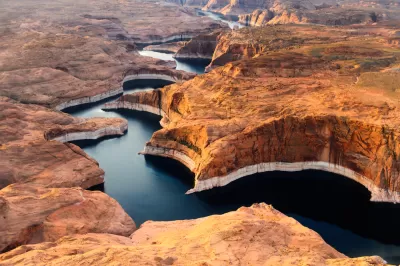
Reporting for the Los Angeles Times, Ian James outlines California’s alternate proposal for managing the Colorado River’s dwindling water resources. “The state put forward its proposal a day after Arizona, Colorado, Nevada, New Mexico, Utah and Wyoming released their alternative.”
California officials claim the state’s “high-priority senior water rights dating back more than a century” must be protected under any new agreement. According to California’s natural resources secretary Wade Crowfoot, “The six-state proposal directly and disproportionately impacts California.” Much of the Colorado River’s Southern California allocations go to the region’s vast farmlands. Per the six-state plan, “A large portion of the cuts they proposed would be made by accounting for evaporation and other water losses along the lower portion of the river — a calculation that would translate into especially large reductions for California, which uses more Colorado River water than any other state.”
As James explains, “The state’s proposal builds on a previous commitment by four Southern California water agencies to cut water use by 400,000 acre-feet per year, a reduction of about 9%, through 2026. The federal government has asked the states to reduce their total usage by 2 to 4 million acre-feet.” California officials call the proposal “a realistic and implementable framework to address reduced inflows and declining reservoir elevations by building on voluntary agreements and past collaborative efforts in order to minimize the risk of legal challenge or implementation delay.” As the states continue to debate, federal officials plan to finalize an agreement this summer.
FULL STORY: California offers proposal on Colorado River crisis, disagreeing with six states

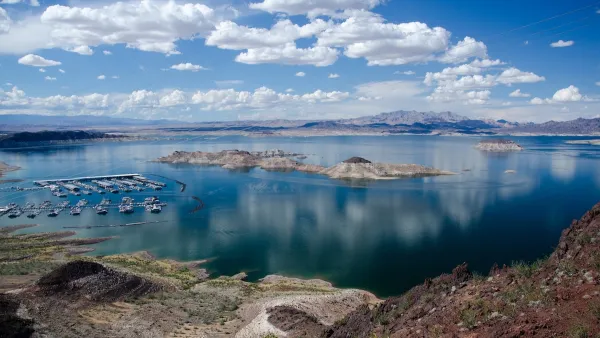
Colorado River States Inch Closer to Agreement
Upper Basin and Lower Basin states each say their plan for conserving the Colorado River’s water is the most sustainable.
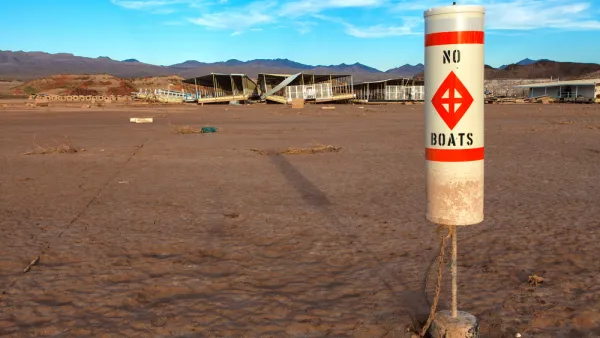
Colorado River Compact Needs 21st Century Update
While the historic agreement set a new precedent for water rights, its inherent flaws, growing demand, and the threat of climate change make much of it obsolete for today’s needs.
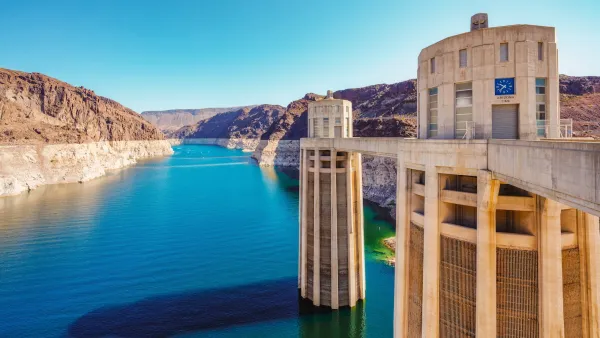
Federal proposal calls for mandatory water cuts to Arizona, California and Nevada
The Bureau of Reclamation stepped in after states failed to come to an agreement over Colorado River water use reductions.

Planetizen Federal Action Tracker
A weekly monitor of how Trump’s orders and actions are impacting planners and planning in America.

The state-sanctioned urbicide of Austin
People don’t kill cities. Freeways do.

US to reduce Colorado River water deliveries to Mexico
A new Colorado Treaty amendment reduces Mexico’s Colorado River water allocation by 250,000 acre feet.

Mamdani overhauls NYC's Vision Zero plan with 100 new policy goals
The overhaul aims to reduce traffic deaths and make streets safer for pedestrians, cyclists and drivers through lower speed limits, new safety infrastructure and more.

Amtrak not solely to blame for New Jersey commuter rail's unreliability, report finds
A new study from the Garden State Initiative found that NJ Transit’s budget grew 20% across a 4 year period, but reliability declined significantly over the same period.

EPA erases limits on planet-warming pollution from power plants
Under Monday’s plan, power plants would still have some limits on how much mercury, arsenic and other contaminants they can emit.

FREE Course: Walkable City 1: Why Walkability?
After describing his path towards focusing on walkability as the essence of good planning, Jeff Speck marches through his five principal reasons for making more walkable places.
Reinventing Malls: Planning Alchemy—Turning Gray Fields Into Gold
The course focuses on the opportunities and imperatives that shape reinvention of mall sites.

Eagle County Government
Harvard University Graduate School of Design
Nashville Planning Department
The Architects Foundation
University of Cincinnati Online
The Pocatello Development Authority
The Urban Renewal Agency of the City of Pocatello
Journal of the American Planning Association