While other countries are boosting investment in their light and heavy rail systems, transit projects in U.S. cities have slowed, signaling diminished commitment to transit expansion.



While countries like Canada, Egypt, France, and others are increasing their investment in high-quality public transit, the United States is falling behind, with the kilometers of rail opened declining by roughly 30 percent between the 2000s and 2010s. Yonah Freemark analyzes the data in The Transport Politic.
According to data from the Transit Explorer (which excludes Australia and south and east Asia), the United States currently has the most kilometers of heavy or light metro rail. Freemark points out that about a third of this network is concentrated in the New York region. “But New York actually has fewer active heavy rail lines in service than it did in 1950,” and transit investment in the city and around the country has slowed in recent years. Neither New York or Chicago have plans to expand their systems in the coming years.
Freemark outlines the different efforts taking place around the world to improve transit. Cairo, Istanbul, Paris, and others are actively building new light rail lines, with Paris set to overtake London and New York for most rail kilometers. While U.S. cities like Los Angeles and Seattle have ambitious plans for expanding their transit systems, Freemark writes, “These conditions overall tell a story of declining US commitment to transit expansion in the context of large growth in other countries around the world.”
Read the full story: Historical Trends Show a Decline in Investment in High–Quality Transit in the US—And an Uptick Elsewhere
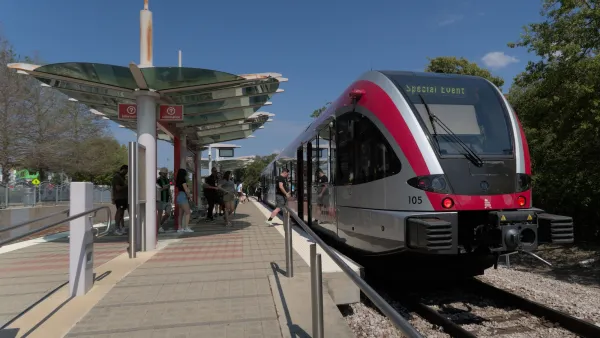
Austin's Project Connect has shrunk to less than half its proposed length — at a higher cost
A highly anticipated light rail project is quickly diminishing in scope as costs soar.
Report: US Transit Returns $5 for Every $1 Invested
An analysis from APTA shows the rippling positive impacts of transit funding.

Austin’s Project Connect Funding Safe for 2025
The light rail project is moving ahead with plans to finalize its environmental impact review by late 2025.

Planetizen Federal Action Tracker
A weekly monitor of how Trump’s orders and actions are impacting planners and planning in America.

California plans to bury El Niño’s downpour
If the state plays its cards right, it may be able to store a billion acre-feet of El Niño’s water in aquifers.

Desperate measures: Advocates weigh draining Lake Powell to fill Colorado River
Draining the reservoir could reduce evaporation losses by a couple hundred thousand acre-feet.

Chicago voters approve permanent festival grounds, penalty for vacant property owners
Currently, major summer and fall festivals take over public parks for weeks at a time, drawing criticism from nearby residents

NYC votes to cut outdoor dining red tape, speed up permitting
New York City also voted to allow the Department of Transportation to begin work on urgent projects before notifying elected officials.

California appears to reject Prop. 45
The proposition would have expanded the projects that qualify for a streamlined environmental review, effectively paring down the California Environmental Quality Act.

FREE Course: Walkable City 1: Why Walkability?
After describing his path towards focusing on walkability as the essence of good planning, Jeff Speck marches through his five principal reasons for making more walkable places.
Reinventing Malls: Planning Alchemy—Turning Gray Fields Into Gold
The course focuses on the opportunities and imperatives that shape reinvention of mall sites.

City of Rosemead
Rutgers University, Edward J. Bloustein School of Planning and Public Policy
One Hundred Miles
Hunter College, City University of New York (CUNY)
The Architects Foundation
University of Cincinnati Online
City of Cambridge
Montrose County
The Pocatello Development Authority