The city is complying with an Oregon state mandate that some cities have challenged in court.



The Bend, Oregon city council voted to adopt the state’s Climate Friendly and Equitable Communities rules, which require many cities to eliminate parking requirements as part of an effort to lower the cost of housing construction, improve affordability, and reduce Oregonians’ reliance on cars. As Barney Lerten reports for KTVZ, some Oregon cities sued to protest the rule.
While some housing advocates praise the move as a positive step toward improving housing affordability and limiting sprawl, some councilmembers worry that Bend isn’t ready for the change, saying the city “doesn’t have the robust public transportation system many others who dropped parking minimums have in place.”
The change removes minimum parking requirements from the city’s development code and adds requirements for electric vehicle charging facilities, but does not prohibit the construction of new parking. Acknowledging concerns about parking availability, Bend Mayor Melanie Kebler said, “Council remains committed to exploring other parking policy reforms that will increase the amount of on-street accessible parking and help us manage the curb in neighborhoods and commercial areas alike.”
Read the full story: Bend councilors get lower-rating survey results, vote 4-2 to adopt state rules, drop parking-space minimums
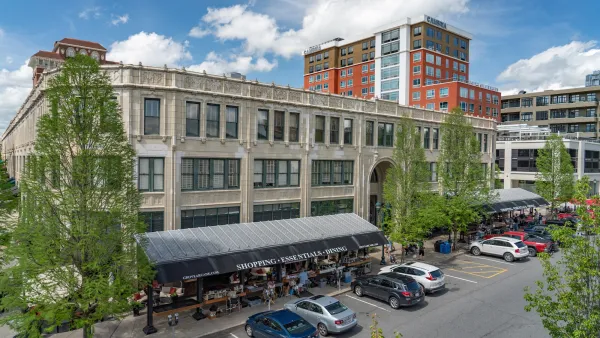
Asheville Could Eliminate Parking Minimums
The city is working on a multiyear overhaul of its Unified Development Ordinance.

Study: Eliminating Parking Requirements Would Boost Denver Housing by 12.5%
Denver and other Colorado cities have recently reduced or eliminate parking requirements, paving the way to more affordable housing development.

Parking Reform Yields New Housing
As more cities eliminate or reduce their minimum parking requirements, the impact on housing supply is coming into focus.

Planetizen Federal Action Tracker
A weekly monitor of how Trump’s orders and actions are impacting planners and planning in America.

California plans to bury El Niño’s downpour
If the state plays its cards right, it may be able to store a billion acre-feet of El Niño’s water in aquifers.

Desperate measures: Advocates weigh draining Lake Powell to fill Colorado River
Draining the reservoir could reduce evaporation losses by a couple hundred thousand acre-feet.

Los Angeles just elected an urban planner as its mayor
Transportation analysts are optimistic that Raman will be more aggressive in addressing transit issues than Bass.

Mamdani’s pied-à-terre tax survives legal challenge
A panel of judges found that the plaintiffs failed to demonstrate injury as a result of New York City's implementation of the tax.

Eastern Nebraska is running out of electricity
Data centers and electrification are straining eastern Nebraska’s grid, throttling economic development.

FREE Course: Walkable City 1: Why Walkability?
After describing his path towards focusing on walkability as the essence of good planning, Jeff Speck marches through his five principal reasons for making more walkable places.
Reinventing Malls: Planning Alchemy—Turning Gray Fields Into Gold
The course focuses on the opportunities and imperatives that shape reinvention of mall sites.

City of Rosemead
Rutgers University, Edward J. Bloustein School of Planning and Public Policy
One Hundred Miles
University of Michigan School for Environment and Sustainability (SEAS)
Hunter College, City University of New York (CUNY)
The Architects Foundation
City of Cambridge
Montrose County
The Pocatello Development Authority