The Federal Highway Administration doesn’t analyze the condition of pavement on U.S. highways. If it did, it would find vast inequities depending on which communities live nearby highway infrastructure.


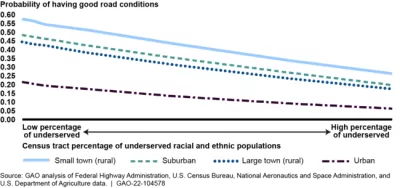
The U.S. Government Accountability Office (GAO) recently released research on the condition of pavement on the nation’s highways—finding that differences in pavement condition break down along income and racial lines.
“Most of the pavement on our nation's highways—covering about 220,000 miles of roads—is in good or fair condition. But highway pavement is less likely to be in good condition in urban areas, localities with higher family poverty rates, and areas with higher percentages of underserved racial and ethnic populations,” according to the website that shares the data.
The website also calls on the Federal Highway Administration to routinely examine state data on pavement conditions to better address inequities in pavement conditions.
“The National Highway System is key to the nation's economy, defense, and mobility. It comprises approximately 220,000 miles of roads and accounts for about 54 percent of all vehicle miles traveled. Poor pavement condition on National Highway System roads could pose safety issues and impede the flow of traffic,” according to the GAO.
At the local level, the city of Oakland, California made news a few years ago by focusing road repair and reconfiguration work in underserved neighborhoods, recognizing the effects of inequity in maintenance work over the years.
FULL STORY: Analysis of Available Data Could Better Ensure Equitable Pavement Condition

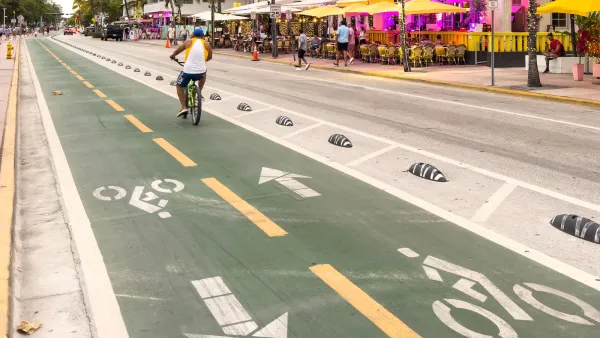
FHWA removes bike lanes and speed cameras from list of traffic safety measures
The agency did not announce its intention to eliminate five proven safety measures from its list of suggested interventions.
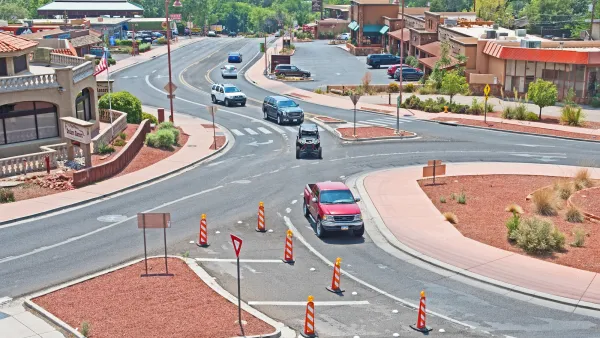
Study: Roundabouts are Primarily in Wealthier Neighborhoods
A North Carolina study sheds light on inequities in road safety interventions.
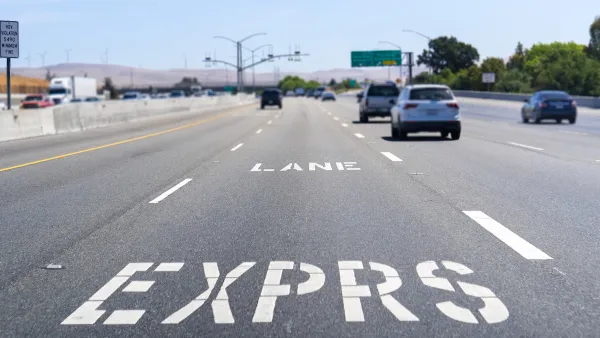
Congestion Pricing in the San Francisco Bay Area
Planners call them “express lanes,” but make no mistake, they are congestion pricing in action, and they're successful. The Bay Area network of what the Federal Highway Administration calls “high-occupancy toll (HOT) lanes” is growing.

Planetizen Federal Action Tracker
A weekly monitor of how Trump’s orders and actions are impacting planners and planning in America.

The state-sanctioned urbicide of Austin
People don’t kill cities. Freeways do.

US to reduce Colorado River water deliveries to Mexico
A new Colorado Treaty amendment reduces Mexico’s Colorado River water allocation by 250,000 acre feet.

5 New England states march closer to 800 megawatt wind energy project
Securing federal approval for the project may be complicated under the Trump administration, which has historically been hostile towards domestic wind power.

Baltimore to break ground on $50 million Transit Priority Project
The project will bring faster bus trips, safer streets and better bike connections to Baltimore.

Airbnb launches $250 million 'last-dollar financing' housing accelerator, makes first investment in Austin
The company will put $6.4 million towards affordable housing development in Texas’ capital.

FREE Course: Walkable City 1: Why Walkability?
After describing his path towards focusing on walkability as the essence of good planning, Jeff Speck marches through his five principal reasons for making more walkable places.
Reinventing Malls: Planning Alchemy—Turning Gray Fields Into Gold
The course focuses on the opportunities and imperatives that shape reinvention of mall sites.

Eagle County Government
Harvard University Graduate School of Design
Nashville Planning Department
The Architects Foundation
University of Cincinnati Online
The Pocatello Development Authority
The Urban Renewal Agency of the City of Pocatello
Journal of the American Planning Association