An as-yet-unfunded proposal to build two new bridges would create essential connections and help riders avoid a mile-plus detour.


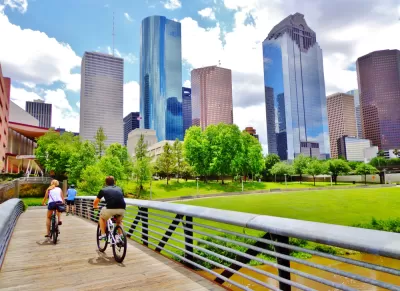
As famously car-centric Houston works to boost its biking infrastructure, a proposal dubbed “A Tale of Two Bridges” could give Houston cyclists a more convenient option for crossing White Oak Bayou, reports Dug Begley in the Houston Chronicle.
Despite some points on either side of the bayou being just 500 feet apart, “Cyclists and runners now must make a roughly 1.6 mile detour via the closest span across the bayou east of T C Jester unless they use city streets that aren’t friendly to anyone outside a car or truck.” That distance can make a crucial difference for people with mobility impairments, Begley points out.
“The proposal cobbles together an open space the Texas Department of Transportation acquired for stormwater detention north of Interstate 10 and White Oak Bayou, current plans for a bridge where Rutland dead ends north of the bayou, and apartment and commercial development on both sides of the bayou at Patterson” to propose adding a second bridge that would make the route more convenient for cyclists and pedestrians.
“TxDOT, with federal money doled out by the Houston-Galveston Area Council, has a $2.4 million plan to build the Rutland bridge, set to start construction in fiscal 2024.” Advocates hope another entity will provide the funding for the Patterson bridge, arguing that the two spans would complement other planned bike lanes and trails and help spur economic development and social activity in the area. As more people adopt biking and walking as essential transportation and recreation modes, providing safe crossings across the bayous that criss-cross the city will be a crucial component of a comprehensive trail network.
Read the full story: White Oak Trail is brimming with riders. Two new bridges could give them somewhere to go, advocates argue.

Houston Mayor Kills Another Bike Lane
The mayor rejected a proposed bike lane in the Montrose district in keeping with his pledge to maintain car lanes.
Houston Mayor Promises Dedicated Austin Street Bike Lane After Public Backlash
Although the one-way bike lane won’t be protected by physical barriers, the proposal is an improvement over the mayor’s initial plan to only include sharrows on the Austin Street project.
Houston Residents Respond to Mobility Questions
What could the city look like if budget and bureaucracy were no object?

Planetizen Federal Action Tracker
A weekly monitor of how Trump’s orders and actions are impacting planners and planning in America.

California plans to bury El Niño’s downpour
If the state plays its cards right, it may be able to store a billion acre-feet of El Niño’s water in aquifers.

Desperate measures: Advocates weigh draining Lake Powell to fill Colorado River
Draining the reservoir could reduce evaporation losses by a couple hundred thousand acre-feet.

Chicago Avenue bridge construction delays enrages city leaders
The bridge has been closed since 2025. The city originally aimed to re-open it in December, and now expects to finish construction in 2027.

NYC bus network redesign speeds up Queens buses
Rush routes have seen a 4.6% speed increase after the redesign.

California High-Speed Rail Authority picks trainset manufacturer
The California High-Speed Rail Authority aims to start servicing passengers by 2033.

FREE Course: Walkable City 1: Why Walkability?
After describing his path towards focusing on walkability as the essence of good planning, Jeff Speck marches through his five principal reasons for making more walkable places.
Reinventing Malls: Planning Alchemy—Turning Gray Fields Into Gold
The course focuses on the opportunities and imperatives that shape reinvention of mall sites.

City of Rosemead
Rutgers University, Edward J. Bloustein School of Planning and Public Policy
One Hundred Miles
Hunter College, City University of New York (CUNY)
The Architects Foundation
University of Cincinnati Online
City of Cambridge
Montrose County
The Pocatello Development Authority