The city’s latest revisions to its Unified Development Ordinance call for expanded parking requirements near residential neighborhoods.


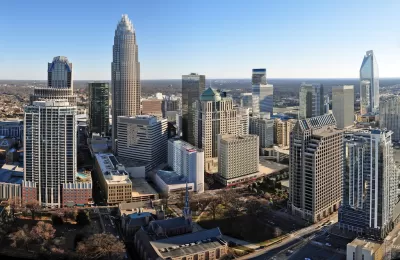
“Despite the fact that Charlotte wants to be less car-reliant, the city, in overhauling its development regulations, is still requiring developers to include a minimum number of parking spots in many new projects, especially those near residential neighborhoods.” As Alexandria Sands reports for WBTV, this is in part due to concerns about the city’s public transit system, which doesn’t serve all parts of the city reliably, as well as the availability of parking in residential areas.
In the city’s latest draft Unified Development Ordinance, “Multi-family housing developments within 400 feet of a low-density housing neighborhood,” which currently have no parking requirements, would require at least one space per housing unit. Certain businesses, such as bars and entertainment venues, within 400 feet of neighborhoods would also have to add parking spots, broadening the requirement from the current 200 feet.
Elsewhere in North Carolina, Raleigh eliminated parking requirements altogether, but uses residential parking permits to regulate non-resident parking in neighborhoods.
Read the full story: Charlotte is stopping short of eliminating parking minimums


Denver Could Eliminate Parking Requirements
The city could remove parking mandates citywide to reduce the cost of housing construction and ease permitting for new projects.
Parking Reform Yields New Housing
As more cities eliminate or reduce their minimum parking requirements, the impact on housing supply is coming into focus.
Dallas Considers Nixing Parking Requirements
According to one local official, Dallas projects routinely build 20 to 30 percent more parking than they need, driving up the cost of housing and leading to unsustainable land use patterns.

Planetizen Federal Action Tracker
A weekly monitor of how Trump’s orders and actions are impacting planners and planning in America.

The state-sanctioned urbicide of Austin
People don’t kill cities. Freeways do.

US to reduce Colorado River water deliveries to Mexico
A new Colorado Treaty amendment reduces Mexico’s Colorado River water allocation by 250,000 acre feet.

Nation's most wind-powered state turns to coal as data centers increase energy demand
For the first time in decades, Iowa has increased its generation of coal power.

NYC cools commuters with city's first rain garden above a bus stop
New York City officials say the plants in the rain garden can absorb 16 gallons of rainwater during heavy storms.

Brightline West’s future may rely on $6 billion federal loan
The company has until Nov. 2 to make a $400 million equity investment into its proposed high-speed rail line.

FREE Course: Walkable City 1: Why Walkability?
After describing his path towards focusing on walkability as the essence of good planning, Jeff Speck marches through his five principal reasons for making more walkable places.
Reinventing Malls: Planning Alchemy—Turning Gray Fields Into Gold
The course focuses on the opportunities and imperatives that shape reinvention of mall sites.

Greater Baltimore Committee
Eagle County Government
Harvard University Graduate School of Design
The Architects Foundation
University of Cincinnati Online
The Pocatello Development Authority
The Urban Renewal Agency of the City of Pocatello
Journal of the American Planning Association