Based on the number of permits issued for new construction in the last year, the city must triple its production to meet the targets set by the state in the latest round of the Regional Housing Needs Assessment.



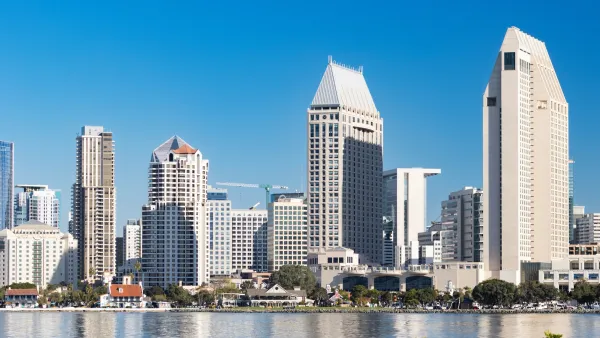
According to an article by Andrew Keatts in Voice of San Diego, the Southern California city, like others around the state, is falling far short of its state-mandated housing construction goal. “The city now needs to triple the number of housing permits it issues in each of the next seven years to meet the state target – a level it hasn’t come close to reaching anytime recently.” As Keatts states, “The city issued permits for 5,033 homes last year, short of the 13,505 the city needs to build each year to achieve the total assigned to it in a statewide housing program called the Regional Housing Needs Assessment.”
Yet “In a progress report headed before the City Council’s housing committee Thursday, city staff did not mention the city was far behind meeting its housing plan.” In the last eight-year cycle of the RHNA, “the state assigned San Diego 88,096 new homes; it ended up issuing permits for just 44,531, according to city reports.” This year, the state cracked down on city housing plans that did not sufficiently address how local jurisdictions would meet state goals, sending many of them back to the drawing board.
Local leaders say some factors inhibiting more housing production are beyond the city’s control, and that the RHNA’s focus on the number of units built (with a large home counting the same as a small studio) obscuring the actual number of people new construction will house.
California cities aren’t the only ones struggling to meet demand for housing. A recent report found that the United States is short of close to 3.8 million housing units.
FULL STORY: One Year In, San Diego Isn’t Anywhere Close to Building the Homes the State Says It Needs


San Diego establishes $8.5M affordable housing fund
The new fund will let local nonprofits and developers apply for funding to shore up the city's affordable housing stock.

San Diego wants to limit upzoning law to just 16% of transit-adjacent parcels
The city's planning director says some areas are unfit for immediate upzoning due to a lack of resources or hazards such as wildfire risk.
San Diego School District Plans to Build 3,000 Homes for Employees
The district wants to offer affordable housing to 10 percent of its staff by 2030.

Planetizen Federal Action Tracker
A weekly monitor of how Trump’s orders and actions are impacting planners and planning in America.

The state-sanctioned urbicide of Austin
People don’t kill cities. Freeways do.

US to reduce Colorado River water deliveries to Mexico
A new Colorado Treaty amendment reduces Mexico’s Colorado River water allocation by 250,000 acre feet.

5 New England states march closer to 800 megawatt wind energy project
Securing federal approval for the project may be complicated under the Trump administration, which has historically been hostile towards domestic wind power.

Baltimore to break ground on $50 million Transit Priority Project
The project will bring faster bus trips, safer streets and better bike connections to Baltimore.

Airbnb launches $250 million 'last-dollar financing' housing accelerator, makes first investment in Austin
The company will put $6.4 million towards affordable housing development in Texas’ capital.

FREE Course: Walkable City 1: Why Walkability?
After describing his path towards focusing on walkability as the essence of good planning, Jeff Speck marches through his five principal reasons for making more walkable places.
Reinventing Malls: Planning Alchemy—Turning Gray Fields Into Gold
The course focuses on the opportunities and imperatives that shape reinvention of mall sites.

Eagle County Government
Harvard University Graduate School of Design
Nashville Planning Department
The Architects Foundation
University of Cincinnati Online
The Pocatello Development Authority
The Urban Renewal Agency of the City of Pocatello
Journal of the American Planning Association