Bipartisan political support, billions in state and federal funding, and an unrelenting drought are creating momentum for the Sites Reservoir project in California's northern Central Valley.


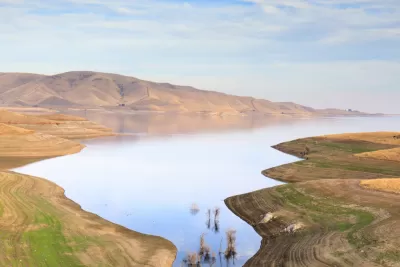
With the state of California facing a historic drought unlikely to fully vanish in the climate changes to come, a long-planned project to build a massive new reservoir, called the Sites Reservoir, is gaining momentum in the state along with other restrictions to reduce the amount of demand on the state’s water system.
“A long-dead proposal to flood a bucolic valley north of Sacramento and create a massive reservoir for thirsty Southern California is finding new life — and opposition — amid the effects of climate change and worsening drought,” reports Louis Sahagún for the Los Angeles Times.
“The $4-billion off-stream reservoir is intended to hold storm water from the Sacramento River and would not dam the river or block fish migration. Operating under the public-private joint powers authority, it would contain, at capacity, 1.5 million acre-feet of water and would be available to investors for consumption, sale or lease,” according to Sahagún.
The reservoir has “bipartisan support led by Gov. Gavin Newsom, $816 million from a voter-approved bond and more than $2.2 billion in loans offered by state and federal agencies,” adds Sahagún. The Metropolitan Water District of Southern California (MWD) also recently appropriated $20 million for project planning.
Planning for the Sites Reservoir dates to the 1950s, although the project seemed to be permanently shelved in the 1980s. More recently however, the plan to build the massive reservoir has gained steam, as the state searches for new resilience in the face of the Western megadrought.
On the demand side of the equation, the state of California recently imposed new water restrictions that "require local water suppliers statewide to activate 'Level 2' of their local contingency plans to prepare for a shortage of up to 20%" starting on June 1, according to a separate article for the Los Angeles Times by Hayley Smith. MWD, for its part, also implemented unprecedented measures on June 1 to lower water use in Southern California, according to another Los Angeles Times article by Ian James.
The source article, linked below, includes details about the political controversy surrounding the Sites Reservoir, which pits agricultural interests against environmental interests. Some environmentalists warn that the project, once complete, “would facilitate development of the controversial Delta Conveyance Project, a.k.a. the Delta Tunnel,” for example.
FULL STORY: California drought resurrects decades-old plan for controversial Sites Reservoir

California’s Reservoirs are Filling Up, but For How Long?
Recent storms are bringing plenty of water to parched parts of California, but scientists warn the relief won’t be a long-term solution to longer, drier periods.
Southern California Water District Declares Drought Emergency
State water officials say the region’s agencies will only receive 5 percent of their requested supplies for the start of 2023 due to intense drought conditions that continue to sap western water supplies.
Declining Water Levels Trigger ‘Stage 1’ Drought Response in Austin
The effects of the megadrought in the American Southwest are reaching into Texas.

Planetizen Federal Action Tracker
A weekly monitor of how Trump’s orders and actions are impacting planners and planning in America.

The state-sanctioned urbicide of Austin
People don’t kill cities. Freeways do.

US to reduce Colorado River water deliveries to Mexico
A new Colorado Treaty amendment reduces Mexico’s Colorado River water allocation by 250,000 acre feet.

Brightline West’s future may rely on $6 billion federal loan
The company has until Nov. 2 to make a $400 million equity investment into its proposed high-speed rail line.

LA Metro’s ultimatum: no extra buses for LA28 if federal funding isn’t imminently secured
If Metro does not provide additional buses, LA28 organizers will have to find a new way to manage Olympic traffic. LA28’s budget does not include a line item for transit.

Colorado’s Largest Data Center Could Rise Next to Homes — Without a Public Hearing
The proposed campus would consume 11 times the power of Denver International Airport; as it has across the country, opposition mounts.

FREE Course: Walkable City 1: Why Walkability?
After describing his path towards focusing on walkability as the essence of good planning, Jeff Speck marches through his five principal reasons for making more walkable places.
Reinventing Malls: Planning Alchemy—Turning Gray Fields Into Gold
The course focuses on the opportunities and imperatives that shape reinvention of mall sites.

Eagle County Government
Harvard University Graduate School of Design
Nashville Planning Department
The Architects Foundation
University of Cincinnati Online
The Pocatello Development Authority
The Urban Renewal Agency of the City of Pocatello
Journal of the American Planning Association