If signed by Governor Gavin Newsom, a new bill would use automated sensors and cameras to enforce decibel limits on cars and motorcycles.



“California has long specified the decibel level at which stock or modified exhaust systems are deemed too loud—95 decibels for cars and 80 for motorcycles built after 1985—and this hasn’t changed,” notes an article by Emmet White in Autoweek. Now, a new bill would implement a five-year automated enforcement pilot program to ramp up enforcement.
“A ‘sound-activated enforcement system’ means sensors are activated when noise levels exceed legal limits, and smart cameras are used ‘to obtain a clear photograph of a vehicle license plate,’ the text of Senate Bill 1079 reads.”
According to the bill, “Signage is required to notify motorists before they enter an enforcement zone. First time offenders will not be charged and only subsequent violations will incur fines. Additionally, participating city governments are required to create payment plans, deferment options, and fine waivers for low-income vehicle owners who demonstrate a temporary or indefinite inability to pay.”
White writes that how well the sensors will function remains to be seen. “It will be curious to gauge the accuracy of the enforcement devices, how manufacturers will continue to alter vehicles for California markets, and if the progressive penalty policies become a blueprint for more equitable traffic enforcement.”
Other states and cities are also experimenting with high-tech solutions to noise pollution as more research reveals the harmful effects of noise on public health.
FULL STORY: California Targets Loud Exhaust with Sound-Activated Camera Enforcement


‘Quiet Parks’ Highlight Importance of Silence for Public Health
The initiative recognizes parks and other areas that preserve natural quiet in a world full of noise pollution.

Estonian Capital Launches Noise Reduction Action Plan
European Union cities are required to create ‘noise maps’ and strategic plans for reducing environmental noise.
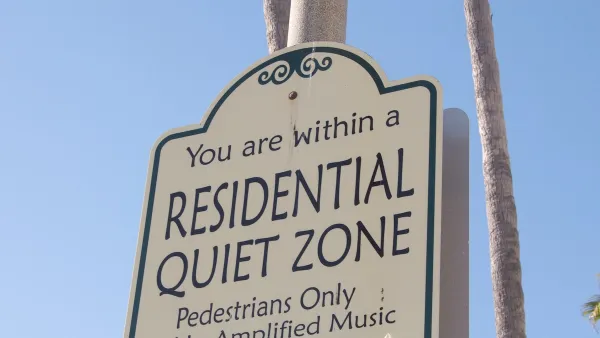
Noise as a Public Health Hazard
New ways of measuring the effects of sound on human health are helping communities fight back against noise pollution.

Planetizen Federal Action Tracker
A weekly monitor of how Trump’s orders and actions are impacting planners and planning in America.

The state-sanctioned urbicide of Austin
People don’t kill cities. Freeways do.

US to reduce Colorado River water deliveries to Mexico
A new Colorado Treaty amendment reduces Mexico’s Colorado River water allocation by 250,000 acre feet.

5 New England states march closer to 800 megawatt wind energy project
Securing federal approval for the project may be complicated under the Trump administration, which has historically been hostile towards domestic wind power.

Baltimore to break ground on $50 million Transit Priority Project
The project will bring faster bus trips, safer streets and better bike connections to Baltimore.

Airbnb launches $250 million 'last-dollar financing' housing accelerator, makes first investment in Austin
The company will put $6.4 million towards affordable housing development in Texas’ capital.

FREE Course: Walkable City 1: Why Walkability?
After describing his path towards focusing on walkability as the essence of good planning, Jeff Speck marches through his five principal reasons for making more walkable places.
Reinventing Malls: Planning Alchemy—Turning Gray Fields Into Gold
The course focuses on the opportunities and imperatives that shape reinvention of mall sites.

Eagle County Government
Harvard University Graduate School of Design
Nashville Planning Department
The Architects Foundation
University of Cincinnati Online
The Pocatello Development Authority
The Urban Renewal Agency of the City of Pocatello
Journal of the American Planning Association