With curbside parking available for free in front of most American homes, residents with private garages often choose to utilize the space for household storage. Putting a price on street parking could change that.


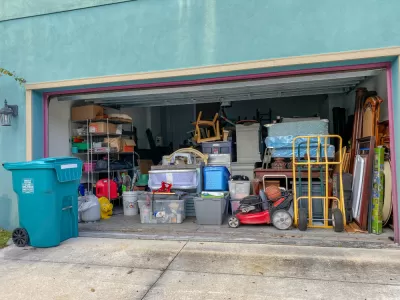
“The government constructs, maintains and distributes free car storage space along the curb in front of almost every house,” asserts Catie Gould, and because of this readily available parking space in single-family neighborhoods, many Americans park their cars on the street and use their garages for other purposes.
“A survey of detached homeowners in Sacramento, California, published in February, showed that when there isn’t space enough for both storing a car and household items, the cars are the items that end up moving elsewhere. The survey found that 37 percent of homeowners didn’t store a single car in their garage.” Surveys from other cities show similar results. A long-range UCLA study “found that 3 of 4 households had too much stuff in their garage to park a car.”
According to Gould, “When storing a car on the curb is free, a garage isn’t necessarily a garage: it’s a great big walk-in closet.” So, Gould asks, “When there is so much evidence that people don’t reliably use private parking spaces to store their cars, why does nearly every city still require them to be built?” Gould explains that these requirements can have a negative impact on housing affordability. “Mandates for off-street parking spaces raise housing costs and prevent housing from being built in the first place.”
Using an example from Vancouver, British Columbia, Gould argues that cities should price curb spaces to incentivize residents to park in their own garages or driveways and free up curbside space for public parking or other uses.
FULL STORY: One in Three Garages Has No Car in It

Reimagining the Curb: How Smart Curb Management is Transforming Urban Mobility
Modern demands for curbside space call for new ways to manage and allocate it.
How the Rise of Delivery Culture is Changing Urban Design
Curb management is quickly becoming a key part of urban planning as delivery vans, ride share vehicles, shared mobility devices, transit, and private cars compete for scarce curb space.
State of Curbs & Parking Report Reveals Glut of Data
As the uses of curb space become more diverse, city officials are working to understand how to best manage this increasingly important urban amenity.

Planetizen Federal Action Tracker
A weekly monitor of how Trump’s orders and actions are impacting planners and planning in America.

The state-sanctioned urbicide of Austin
People don’t kill cities. Freeways do.

US to reduce Colorado River water deliveries to Mexico
A new Colorado Treaty amendment reduces Mexico’s Colorado River water allocation by 250,000 acre feet.

5 New England states march closer to 800 megawatt wind energy project
Securing federal approval for the project may be complicated under the Trump administration, which has historically been hostile towards domestic wind power.

Baltimore to break ground on $50 million Transit Priority Project
The project will bring faster bus trips, safer streets and better bike connections to Baltimore.

Airbnb launches $250 million 'last-dollar financing' housing accelerator, makes first investment in Austin
The company will put $6.4 million towards affordable housing development in Texas’ capital.

FREE Course: Walkable City 1: Why Walkability?
After describing his path towards focusing on walkability as the essence of good planning, Jeff Speck marches through his five principal reasons for making more walkable places.
Reinventing Malls: Planning Alchemy—Turning Gray Fields Into Gold
The course focuses on the opportunities and imperatives that shape reinvention of mall sites.

Eagle County Government
Harvard University Graduate School of Design
Nashville Planning Department
The Architects Foundation
University of Cincinnati Online
The Pocatello Development Authority
The Urban Renewal Agency of the City of Pocatello
Journal of the American Planning Association