A new way of keeping track of the changes caused by one of the nation's "most ambitious urban redevelopment projects."



Josh Green shares news of an interactive data mapping tool published online by the Atlanta Beltline in partnership with Neighborhood Nexus.
Atlanta BeltLine has published two maps—the Investment Data Explorer and the Demographic Data Explorer. Together, according to Green, the maps are "convenient means of keeping tabs on changes brought, in part, by one of America’s most ambitious urban redevelopment projects."
The Investment Data Explorer, "drills down on funding and progress across BeltLine subareas related to parks, housing, trails, transit and streetscapes, and arts and culture," explains Green. The Demographic Data Explorer "vividly illustrates shifts in population densities, incomes, rent growth, and other metrics since the BeltLine’s conception."
The source article below provides more background and insight into the interactive data tools.
Read the full story: Atlanta BeltLine launches gentrification-o-meter to track changes

Atlanta City Council unanimously backs $3.5 billion Beltline light rail project
The resolution was drafted after Atlanta Mayor Andre Dickens pulled support for the Atlanta Streetcar extension last year.
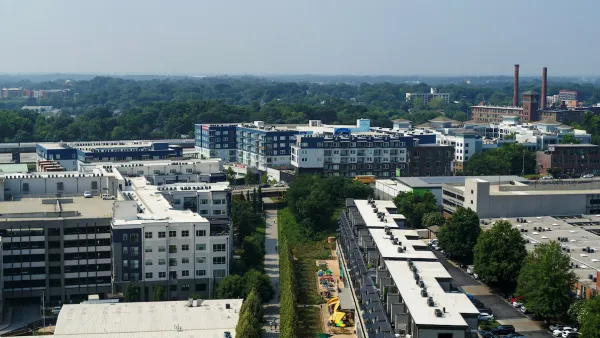
New Study Commissioned for Atlanta BeltLine Transit
The study will assess alignment options for a 13-mile segment of the greenway.

Atlanta Streetcar Expansion Still Moving Forward
MARTA has drastically reduced its plans to construct new rail transit, but one project still has political support from the top at City Hall.

Planetizen Federal Action Tracker
A weekly monitor of how Trump’s orders and actions are impacting planners and planning in America.

California plans to bury El Niño’s downpour
If the state plays its cards right, it may be able to store a billion acre-feet of El Niño’s water in aquifers.

Desperate measures: Advocates weigh draining Lake Powell to fill Colorado River
Draining the reservoir could reduce evaporation losses by a couple hundred thousand acre-feet.

Mamdani’s pied-à-terre tax survives legal challenge
A panel of judges found that the plaintiffs failed to demonstrate injury as a result of New York City's implementation of the tax.

Eastern Nebraska is running out of electricity
Data centers and electrification are straining eastern Nebraska’s grid, throttling economic development.

Seattle passes record-breaking transit services expansion
Proposition 1 will double the city’s transit tax to add 95,000 more bus trips and preserve 180,000 bus trips annually.

FREE Course: Walkable City 1: Why Walkability?
After describing his path towards focusing on walkability as the essence of good planning, Jeff Speck marches through his five principal reasons for making more walkable places.
Reinventing Malls: Planning Alchemy—Turning Gray Fields Into Gold
The course focuses on the opportunities and imperatives that shape reinvention of mall sites.

City of Rosemead
Rutgers University, Edward J. Bloustein School of Planning and Public Policy
One Hundred Miles
University of Michigan School for Environment and Sustainability (SEAS)
Hunter College, City University of New York (CUNY)
The Architects Foundation
City of Cambridge
Montrose County
The Pocatello Development Authority