A closely watched rezoning effort in New York City cleared a key City Council committee last week, while making some concessions from the original vision to get across the finish line.


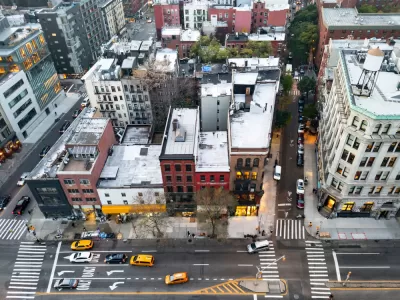
Kathryn Brenzel reports for TheRealDeal that the New York City Council has reached a compromise to get Envision SoHo/NoHo one critical step closer to full approval, dialing back some of the density in the vision for this relatively wealthy corner of Manhattan.
The version of the plan approved by the City Council's Committee on Land Use last week "reduces the commercial floor-area ratio in most of the rezoning area to 5 from the original proposal, in which FAR was 10 in three areas," reports Brenzel. "In the Bowery corridor in Noho, the commercial FAR is 7 and the residential FAR is 12, as recommended by City Planning."
"Despite the last-minute changes, the plan as a whole will dramatically increase the amount of development allowed in the high-income, relatively low-scale neighborhoods. It is a victory for the administration and advocates for affordable housing, not to mention the real estate industry," writes Brenzel.
Planners in New York City began working on the controversial rezoning plan in 2018, and the narrative about the rezoning process quickly turned to relative wealth of the neighborhoods included in the plan compared to other parts of the city rezoned during the de Blasio administration (advocates are pushing the city to for rezone for more residential density in other affluent parts of the city in the wake of Envision SoHo/NoHo).
More details on the final plan are available in the source article linked below. An earlier article by Brenzel, published two days earlier, detailed the political maneuvers that preceded to the compromise.
Read the full story: City Council tweaks Soho rezoning, assuring its passage

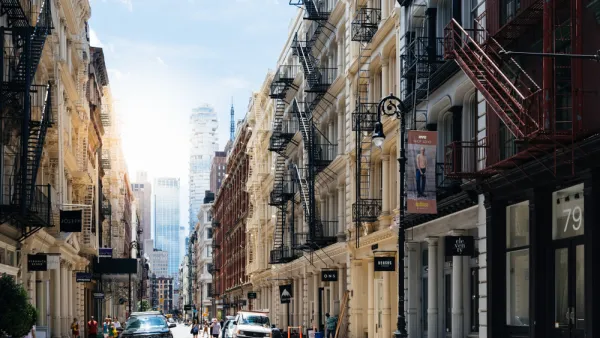
Too Much Commercial Zoning for Affordable Housing in SoHo's Controversial Rezoning Plan?
Mayor Bill de Blasio is crossing the finish line of his time in office at the same time as one of the most controversial rezoning processes of his administration.
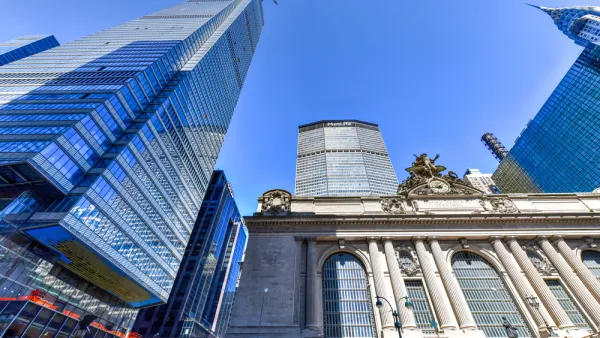
New Supertall Planned for Grand Central Station-Adjacent Property
A new supertall skyscraper will rise at 175 Park Avenue, rising next to famous neighbors on a prime block in Manhattan.
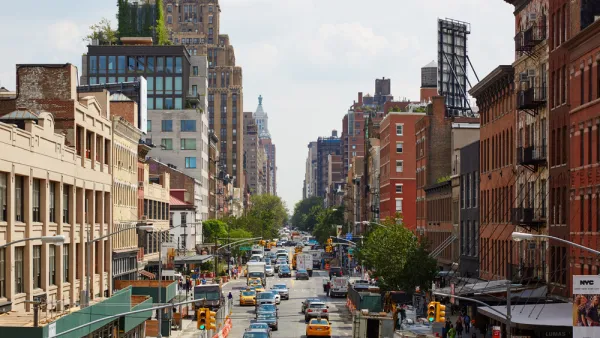
Five More Affluent NYC Neighborhoods to Upzone
In keeping with the goals of the Regional Plan Association's Fourth Regional Plan, New York City must continue its nascent trend of rezoning for more building capacity in affluent neighborhoods.

Planetizen Federal Action Tracker
A weekly monitor of how Trump’s orders and actions are impacting planners and planning in America.

Amtrak, CN end decades-long dispute with eight-year agreement
The new operating agreement establishes an updated framework for the companies to work together, including processes to resolve disputes.

Judges permit Denver to divert 77,000 acre feet from the Colorado River for reservoir expansion
Overuse and climate change have caused the Colorado River’s water levels to plummet.

Boston has spent millions making the Green Line more accessible — and there’s no end in sight
While the city has invested millions into expanding and adding platforms to the Green Line to make it more accessible, new train cars set to arrive next year will be too tall for disabled passengers to board without raising the current platforms.

Idaho may see an 18% drop in federal surface transit funding — the largest estimated cut in the US
Transit systems in rural communities are much more reliant on federal funding to provide their services.

How ‘post-disaster gentrification’ alters neighborhoods after natural calamities
After hurricanes, fires or other calamities, the original residents of a community are often replaced by younger, wealthier residents.

FREE Course: Walkable City 1: Why Walkability?
After describing his path towards focusing on walkability as the essence of good planning, Jeff Speck marches through his five principal reasons for making more walkable places.
Reinventing Malls: Planning Alchemy—Turning Gray Fields Into Gold
The course focuses on the opportunities and imperatives that shape reinvention of mall sites.

City of Wisconsin Rapids
Harvard University Graduate School of Design
KFH Group Inc.
The Architects Foundation
University of Cincinnati Online
The Pocatello Development Authority
The Urban Renewal Agency of the City of Pocatello