Critics of pedestrian crosswalk buttons say the devices, meant to help improve bus speeds, give pedestrians the 'absolute lowest priority' on city streets.


Pedestrian advocates are unhappy with AC Transit's decision to install more crosswalk push buttons in East Bay cities, reports Roger Rudick.
Also known as 'beg buttons,' the devices let pedestrians push a button when they come to an intersection, signaling their need to cross, but critics argue that the buttons "give pedestrians the absolute lowest priority, sometimes forcing them to wait through entire signal cycles before they can cross legally." The agency did not conduct any public outreach regarding the buttons, writes Rudick, which they see as simple 'signal improvements' to improve traffic flow for buses.
But that doesn’t mean pedestrians should be given short shrift by making them push a button and wait through an entire cycle of the light before they are forced to dash across every intersection whether or not a bus is approaching.
According to Rudick and Streetsblog, "this is exactly the kind of implementation that flies in the face of equity," prioritizing people in cars over pedestrians and cyclists.
Read the full story: East Bay Cities Sneak in Beg Buttons

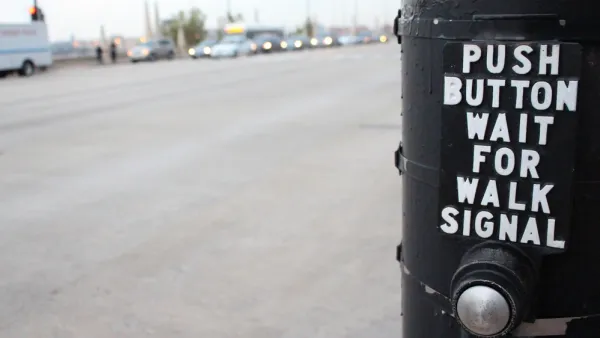
What Walk Buttons Do (and Don't Do)
Are pedestrian walk buttons effective, or do they only give us the illusion of control? It can vary.
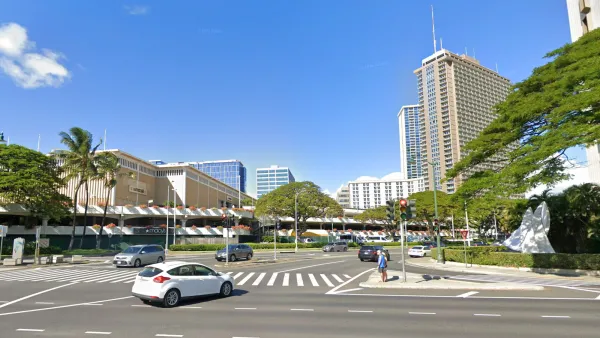
Hawaii DOT takes action after reporters call attention to dangerous crosswalk
The state made changes to a treacherous intersection after reporting revealed that traffic light timing was posting a threat to pedestrians.

Crosswalks Near NYC Schools More Dangerous Than Average
A child and a crossing guard were killed in school crosswalks within one week as the NYPD cuts crossing guard jobs.

Planetizen Federal Action Tracker
A weekly monitor of how Trump’s orders and actions are impacting planners and planning in America.

California plans to bury El Niño’s downpour
If the state plays its cards right, it may be able to store a billion acre-feet of El Niño’s water in aquifers.

Chicago breaks ground on $3 billion megadevelopment
The new neighborhood, titled Foundry Park, will one day host 3,700 residences.

Satanic place names
From streams and lakes to valleys and canyons, I mapped more than 1,000 places named after the Devil.

California High-Speed Rail Authority CEO resigns after $600,000 scandal
Under Ian Choudri, the authority used taxpayer dollars to fund first class flights and trips to nightclubs.

Want to study the Missouri River? Soon, you may need unanimous approval from 10 states
Legislation would require 10 governors’ permission to study or build projects moving water outside the basin.

FREE Course: Walkable City 1: Why Walkability?
After describing his path towards focusing on walkability as the essence of good planning, Jeff Speck marches through his five principal reasons for making more walkable places.
Reinventing Malls: Planning Alchemy—Turning Gray Fields Into Gold
The course focuses on the opportunities and imperatives that shape reinvention of mall sites.

City of Rosemead
Rutgers University, Edward J. Bloustein School of Planning and Public Policy
One Hundred Miles
Hunter College, City University of New York (CUNY)
The Architects Foundation
University of Cincinnati Online
City of Cambridge
Montrose County
The Pocatello Development Authority