The city's new regulations pave the way for making the pandemic experiment a permanent fixture.


As Lori Weisberg reports, the San Diego City Council approved new regulations that will make permanent the city's outdoor dining program, started during the pandemic to support struggling restaurants as COVID-19 forced businesses to adjust to social distancing guidelines. The program "will allow restaurant owners to extend their outdoor seating onto sidewalks, and in metered and unmetered parking spaces in front of their venues as long as they pay a fee, a requirement that up until now has not been imposed."
The new program, called Spaces as Places, will start next July and "include a number of design and safety regulations that will permit restaurants to install platforms for seating along unpainted, yellow or green curbs as long as they are at least 20 feet away from an intersection, street corner, alley or driveway." The new regulations only permit outdoor dining on streets with a maximum speed limit of 30 miles per hour.
Repurposing curb space and parking lots for outdoor dining has become a hallmark of the COVID-19 pandemic as restaurants looked for creative ways to continue serving customers. Cities all over the U.S. scrambled to implement outdoor dining regulations and permitting. Now, as the pandemic and temporary outdoor dining programs wind down, city leaders must decide on the future of 'al fresco streets.'
FULL STORY: Like dining in the street? San Diego decides to make pandemic experiment permanent for restaurants

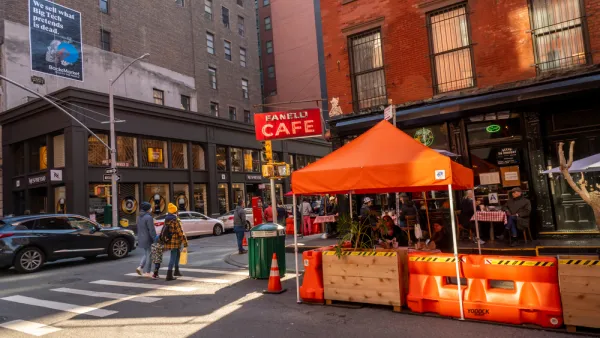
Opinion: Keep Outdoor Dining Without Thwarting Creativity
While New York City's effort to make its outdoor dining program permanent is a welcome reimagining of public space, some worry that regulations will reduce design diversity and increase costs for small restauranteurs.
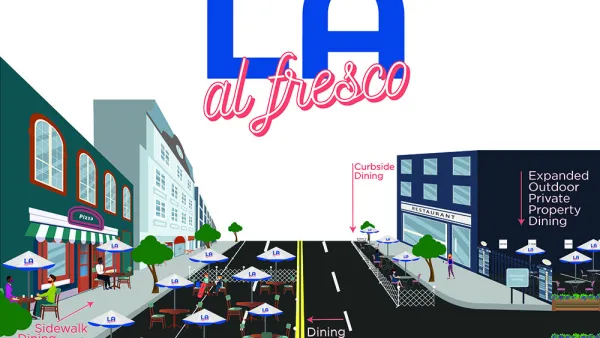
Los Angeles Extends Outdoor Dining Program for Up to Three Years
An emergency ordinance signed by the city's mayor will allow restaurants to keep outdoor dining facilities built during the pandemic for at least one more year.
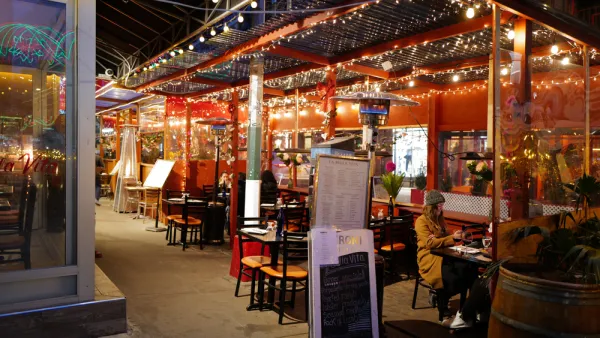
Who Should Manage New York’s Outdoor Dining Program?
A proposal to shift responsibility away from the Department of Transportation has met staunch resistance from industry groups and advocates of the program.

Planetizen Federal Action Tracker
A weekly monitor of how Trump’s orders and actions are impacting planners and planning in America.

The state-sanctioned urbicide of Austin
People don’t kill cities. Freeways do.

US to reduce Colorado River water deliveries to Mexico
A new Colorado Treaty amendment reduces Mexico’s Colorado River water allocation by 250,000 acre feet.

Mamdani overhauls NYC's Vision Zero plan with 100 new policy goals
The overhaul aims to reduce traffic deaths and make streets safer for pedestrians, cyclists and drivers through lower speed limits, new safety infrastructure and more.

Amtrak not solely to blame for New Jersey commuter rail's unreliability, report finds
A new study from the Garden State Initiative found that NJ Transit’s budget grew 20% across a 4 year period, but reliability declined significantly over the same period.

EPA erases limits on planet-warming pollution from power plants
Under Monday’s plan, power plants would still have some limits on how much mercury, arsenic and other contaminants they can emit.

FREE Course: Walkable City 1: Why Walkability?
After describing his path towards focusing on walkability as the essence of good planning, Jeff Speck marches through his five principal reasons for making more walkable places.
Reinventing Malls: Planning Alchemy—Turning Gray Fields Into Gold
The course focuses on the opportunities and imperatives that shape reinvention of mall sites.


Eagle County Government
Harvard University Graduate School of Design
Nashville Planning Department
The Architects Foundation
University of Cincinnati Online
The Pocatello Development Authority
The Urban Renewal Agency of the City of Pocatello
Journal of the American Planning Association