Over the last three decades, the D.C. region has seen the most development in far-flung exurbs disconnected from area jobs and transit networks.


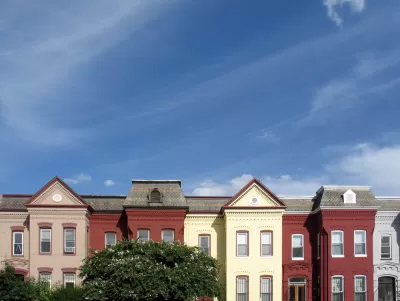
A report from the Brookings Institution claims that new housing in the Washington, D.C. region is too dispersed, failing to take advantage of the area's "highly centralized" public transportation and job centers. "Large employment centers and transit infrastructure are durable features of the built environment that persist for many decades. Therefore, a climate-friendly growth strategy for the region would concentrate new housing, retail, and services around these existing locations." But as Jenny Schuetz and Matt Ring write, "[t]he vast majority of new homes there have been built in low-density exurban or suburban counties—well outside existing public transportation networks. The fastest-growing communities are over 20 miles from the region’s primary employment center."
The report illustrates the growth of housing in the region's different areas and concludes that the "region’s housing growth over the past 30 years has mixed implications for climate impacts," as rates of construction grow for both multi-family buildings near the urban core single-family homes in car-dependent exurban communities. The authors also warn that "[t]he absence of development in job- and transit-rich centrally located neighborhoods throughout the District, Fairfax County, and Montgomery County," a result of opposition from homeowners and low-density zoning laws, "harm[s] more than the physical environment." These anti-growth efforts "exacerbate long-standing economic and racial inequality and push low-income households into longer commutes from distant exurbs."
Read the full story: The Washington, DC region has built too much housing in the wrong places


Yes, another thing that car dependency makes worse: DUIs
In the land of the free (and the cars), design incites drinking and driving.

Cost of living too high? Planners to the rescue!
Excessive costs of living force many people to work more than optimal hours, leaving less time for family and fun. Local policies that favor affordable housing and transportation increase freedom, opportunity and happiness.
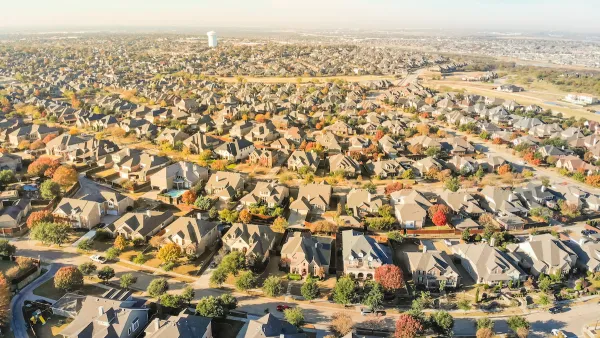
Zoning for Good
A new book highlights the power of zoning to change communities for the better.

Planetizen Federal Action Tracker
A weekly monitor of how Trump’s orders and actions are impacting planners and planning in America.

Amtrak, CN end decades-long dispute with eight-year agreement
The new operating agreement establishes an updated framework for the companies to work together, including processes to resolve disputes.

Judges permit Denver to divert 77,000 acre feet from the Colorado River for reservoir expansion
Overuse and climate change have caused the Colorado River’s water levels to plummet.

NYC DOT wants faster, more permanent street upgrades
The city is examining ways to build more concrete infrastructure without getting entangled in 'decades-long' projects.

'Something we’ve never seen before:' rising utility rates could strain city finances nationwide
Data centers, climate change and other factors have caused utility rates in the United States to increase by 38% since 2020.

Trump to overrule local leaders, lease millions of acres of America’s Pacific Island territories’ seafloors to mining companies
International law says that the Indigenous people of America’s territories have a right to prior and informed consent regarding projects that impact their countries.

FREE Course: Walkable City 1: Why Walkability?
After describing his path towards focusing on walkability as the essence of good planning, Jeff Speck marches through his five principal reasons for making more walkable places.
Reinventing Malls: Planning Alchemy—Turning Gray Fields Into Gold
The course focuses on the opportunities and imperatives that shape reinvention of mall sites.

Harvard University Graduate School of Design
KFH Group Inc.
Greater Baltimore Committee
The Architects Foundation
University of Cincinnati Online
The Pocatello Development Authority
The Urban Renewal Agency of the City of Pocatello