While planning departments around the country make news for removing exclusionary zoning and parking requirements, many neighborhoods still show a strong preference for parking minimums and development limits. Case in point: Germantown, Philadelphia.


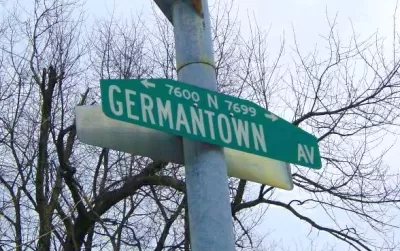
"The Philadelphia City Planning Commission, or PCPC, is eying a rezoning plan for northern Germantown, with a focus on imposing new rules mandating developers provide parking with their projects and putting limitations on building," reports Ryan Briggs.
The "Germantown North Zoning Remapping" is currently under public review, and is clearly tailored to respond to local concerns about perceived parking problems and development in the historic neighborhood.
"Perhaps most significantly, the plan would expand an existing parking overlay along Germantown Avenue to an area between Rittenhouse to Johnson streets," reports Briggs. "The overlay mandates that any new developments that feature more than 10 units provide off-street parking lots or garages."
According to Briggs, some of the development disincentives included in the rezoning don't match the vision set forth by the citywide Philadelphia 2035 plan adopted in 2011—the first new comprehensive plan for the city in 50 years.
In its own citywide “Philadelphia 2035” planning guidelines, the City Planning Commission broadly set a goal of directing more “multifamily housing development to commercial streets and train stations” in the same area now targeted for rezoning. But parts of the proposed rezoning along Germantown Ave, which hosts transit agency SEPTA’s Route 23 bus, would instead make some of those developments more complex and difficult to construct.
More details on the changes that would be implemented with the currently proposed zoning map are included in the source article.
Read the full story: Germantown rezoning highlights neighborhood tensions over parking, density

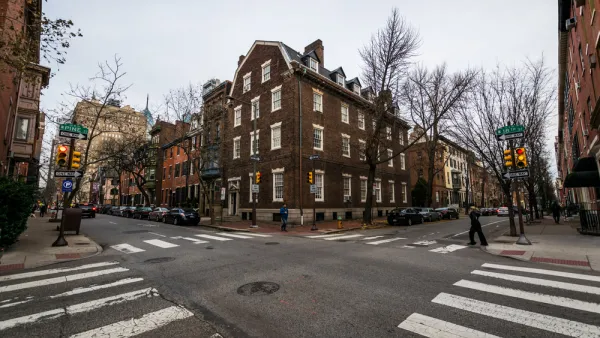
Downzoning for Society Hill Back on After the Philadelphia City Council Overrides Mayoral Veto
One of the wealthiest neighborhoods in Philadelphia is increasing parking requirements and limiting building heights at all costs.
Mayoral Veto Kills Controversial Philadelphia Downzoning
The mayor, planning staff, and the Philadelphia Planning Commission agree. The Philadelphia City Council and residents of the wealthy neighborhood of Society Hill, not so much.
Newly Exclusionary Zoning Expected for Approval in Philadelphia Neighborhood
The Philadelphia City Council is expected to approve new zoning for Society Hill over the objections of the Planning Commission and city planning staff.

Planetizen Federal Action Tracker
A weekly monitor of how Trump’s orders and actions are impacting planners and planning in America.

California plans to bury El Niño’s downpour
If the state plays its cards right, it may be able to store a billion acre-feet of El Niño’s water in aquifers.

Chicago breaks ground on $3 billion megadevelopment
The new neighborhood, titled Foundry Park, will one day host 3,700 residences.

California High-Speed Rail Authority CEO resigns after $600,000 scandal
Under Ian Choudri, the authority used taxpayer dollars to fund first class flights and trips to nightclubs.

Want to study the Missouri River? Soon, you may need unanimous approval from 10 states
Legislation would require 10 governors’ permission to study or build projects moving water outside the basin.

Desperate measures: Advocates weigh draining Lake Powell to fill Colorado River
Draining the reservoir could reduce evaporation losses by a couple hundred thousand acre-feet.

FREE Course: Walkable City 1: Why Walkability?
After describing his path towards focusing on walkability as the essence of good planning, Jeff Speck marches through his five principal reasons for making more walkable places.
Reinventing Malls: Planning Alchemy—Turning Gray Fields Into Gold
The course focuses on the opportunities and imperatives that shape reinvention of mall sites.


City of Rosemead
Rutgers University, Edward J. Bloustein School of Planning and Public Policy
One Hundred Miles
Hunter College, City University of New York (CUNY)
The Architects Foundation
University of Cincinnati Online
City of Cambridge
Montrose County
The Pocatello Development Authority