World Oil, an energy publication, slightly annotated a Bloomberg News article to expose the hypocrisy of the Biden administration: curtailing oil production at home while pushing to increase it abroad.


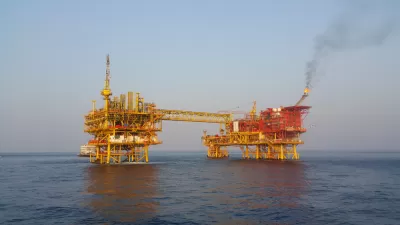
The title of the Bloomberg News article, "Biden Officials Urge OPEC Members to Find Output Compromise," doesn't grab the attention that World Oil, a publication of Gulf Energy Information, assigned it: "Drill baby drill? Biden administration wants more OPEC oil."
The substance of the article is a disagreement with two of the world's largest oil producers, Saudi Arabia and the United Arab Emirates, and the Biden administration's desire to see it resolved, reports Jennifer Jacobs on July 6.
Several days of tense talks among members of the Organization of Petroleum Exporting Countries and its allies failed to resolve a bitter dispute between Saudi Arabia and the United Arab Emirates...The group didn’t agree on a date for its next meeting...
Oil Demand and Production
The dispute centers on the ability of OPEC to boost oil production to meet increasing demand, reports Trevor Filseth for The National Interest on July 12.
As the COVID-19 pandemic draws to a close with increasing vaccination rates, many people around the world have resumed travel, increasing demand for gasoline. Because OPEC+ has not reached an agreement, though, oil supply has remained stable, leading to price increases. Brent crude has increased by roughly one percent over the past week, trading at roughly $75 per barrel; these prices are the highest since 2018.
Oil prices a Biden concern
"Even though the U.S. isn’t a party to the talks, it’s 'closely monitoring the OPEC+ negotiations and their impact on the global economic recovery from the Covid-19 pandemic,' a White House spokesperson said Monday [July 5]," added Jacobs.
Biden wants Americans to have access to affordable and reliable energy, including at the pump, the White House officials said. As the U.S. economy recovers from the Covid-19 pandemic, it’s critical that energy supplies keep pace, which requires stable oil market conditions, they said.
World Oil's annotation
World Oil, whose mission is “defining conventional, shale and offshore technology for oil and gas,” added one sentence to Jacobs' piece.
The administration’s interest in increasing foreign oil production stands in stark contrast to its opposition to domestic output, kicked off on Biden’s first day in office with a moratorium on oil and gas exploration on Federal lands.
"In an effort to slow the nation's contribution to climate change, President Biden has signed an executive order to begin halting oil and gas leasing on federal lands and waters," reported NPR on Jan. 27, a week after the new president's inauguration. Apparently keeping oil prices low by boosting oil production abroad doesn't factor into the administration's climate mitigation goals.
Not the first energy/climate contradiction
Two related posts point to Biden's priority of cheap gasoline prices, even at the expense of maintaining and improving transportation infrastructure by opposing the indexing of the federal gas tax as well as hiking the gas tax, the closest measure the U.S. has to a carbon tax.
- The Big Taboo of the Senate's Bipartisan Infrastructure Proposal, June 17, 2021
- Biden Administration Rules Out Gas Tax Hike, February 1, 2021
It's also not the first time that the administration has looked abroad to increase natural resources rather than increase their production at home which would likely encounter opposition from the environmental community.
Correspondent's note: The source article is the Bloomberg News article via BloombergQuint – an India-based Bloomberg outlet that doesn't have a paywall.
Read the full story: Biden Officials Urge OPEC Members to Find Output Compromise
OPEC Plus Decision to Reduce Oil Output Could Lead to Global Recession
A decision earlier this month by a group of the world's largest oil exporters to drastically reduce oil production to stem the decline in oil prices could be a ‘tipping point’ for a global recession, says the International Energy Agency.
U.S. on Track to Record Oil Production This Year
The current U.S. record is 10 million barrels per day set in 1970. Last year averaged 9.2 million b/d. Experts believe that record will be reached this spring, if it hasn't already. Can Trump claim credit for the surging production?
Motorists have OPEC to Thank for Lowest Oil Prices in Five Years
American motorists are enjoying the lowest gasoline prices in five years because OPEC chose not to reduce oil output in the hopes that decreased oil prices will be lower than the cost needed to frack oil from shale.

Planetizen Federal Action Tracker
A weekly monitor of how Trump’s orders and actions are impacting planners and planning in America.

Eastern Nebraska is running out of electricity
Data centers and electrification are straining eastern Nebraska’s grid, throttling economic development.

Study reveals best places in the U.S. for cycling, walking
New research from Streetlight Data examines bicycle and pedestrian miles per capita in the 100 largest U.S. cities by population.

Next-generation nuclear reactors are coming to Texas
The reactors will not require towering containment structures thanks to new safety features.

California distributes $1.3 billion to prevent transit service cuts, bolster projects
Twenty-eight projects across California received a portion of the funding.

Pennsylvania Democrats have 15 affordability, clean energy bills for flipped state Senate
Bills in consideration include a bill supporting geothermal energy and a bill supporting solar on warehouses.

FREE Course: Walkable City 1: Why Walkability?
After describing his path towards focusing on walkability as the essence of good planning, Jeff Speck marches through his five principal reasons for making more walkable places.
Reinventing Malls: Planning Alchemy—Turning Gray Fields Into Gold
The course focuses on the opportunities and imperatives that shape reinvention of mall sites.

City of Charlotte
City of Rosemead
Rutgers University, Edward J. Bloustein School of Planning and Public Policy
University of Michigan School for Environment and Sustainability (SEAS)
Hunter College, City University of New York (CUNY)
The Architects Foundation
City of Cambridge
The Pocatello Development Authority
The Urban Renewal Agency of the City of Pocatello