Twenty-eight projects across California received a portion of the funding.


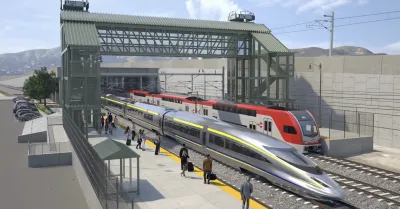
California Gov. Gavin Newsom has distributed almost $1.3 billion in California State Transportation Agency’s Transit and Intercity Rail Capital Program and State Rail Assistance program funding to 28 projects across the state. The funding will go toward bolstering passenger rail service and expanding clean transportation across California, Brandon Lewis writes for Mass Transit.
“The funding will also help prevent major Metrolink service cuts in Southern California, advance Caltrain’s extension into downtown San Francisco and bring more than 75 zero-emission buses and smaller transit vehicles to communities across the state. The investments connect California’s climate goals with everyday needs: dependable transportation to work, school and other destinations,” Mass Transit reports.
The Portal, a major project in the Bay Area that will extend Caltrain by two miles, received $750 million of Newsom’s investment. The project will also establish the future San Fransisco terminus of California’s high-speed rail.
Read the full story: California Gov. Newsom awards $1.3 billion in TIRCP funding for transit projects
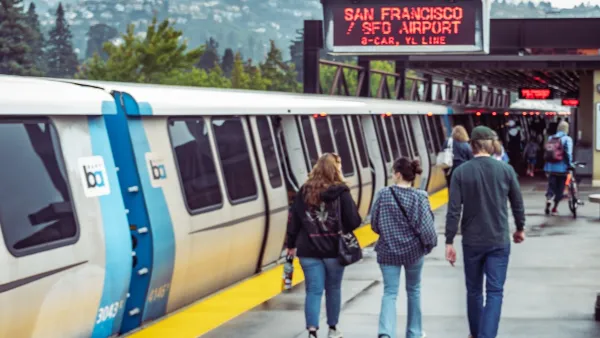
Bay area voters pass ‘crucial lifeline’ for transit
Proposition RTM, which will fund Bay Area transit, has approval from 61% of voters as of 9:45 p.m. on Nov. 3.
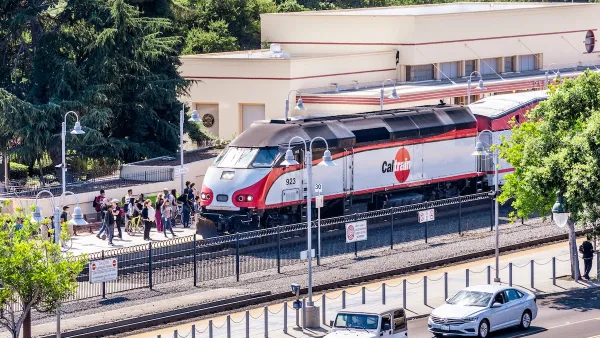
Caltrain may slash over one-third of its stations
If Bay Area voters reject two transit tax measures, Caltrain, BART and AC Transit will see steep service cuts.

Despite 47% growth in ridership, Caltrain could close a third of its stations
Riders can currently travel up to 79 miles between San Francisco and Gilroy, California.

Planetizen Federal Action Tracker
A weekly monitor of how Trump’s orders and actions are impacting planners and planning in America.

Eastern Nebraska is running out of electricity
Data centers and electrification are straining eastern Nebraska’s grid, throttling economic development.

Study reveals best places in the U.S. for cycling, walking
New research from Streetlight Data examines bicycle and pedestrian miles per capita in the 100 largest U.S. cities by population.

California distributes $1.3 billion to prevent transit service cuts, bolster projects
Twenty-eight projects across California received a portion of the funding.

Pennsylvania Democrats have 15 affordability, clean energy bills for flipped state Senate
Bills in consideration include a bill supporting geothermal energy and a bill supporting solar on warehouses.

Denver city council candidate hopes to transform transit lots into housing
Denver’s Regional Transportation District’s parking lots have vacancy rates around 80%.

FREE Course: Walkable City 1: Why Walkability?
After describing his path towards focusing on walkability as the essence of good planning, Jeff Speck marches through his five principal reasons for making more walkable places.
Reinventing Malls: Planning Alchemy—Turning Gray Fields Into Gold
The course focuses on the opportunities and imperatives that shape reinvention of mall sites.

City of Charlotte
City of Rosemead
Rutgers University, Edward J. Bloustein School of Planning and Public Policy
University of Michigan School for Environment and Sustainability (SEAS)
Hunter College, City University of New York (CUNY)
The Architects Foundation
City of Cambridge
The Pocatello Development Authority
The Urban Renewal Agency of the City of Pocatello