The world's most famous, and influential, bus rapid transit system, which served 2.4 million riders a day in Bogotá in the days before the pandemic, offers lessons in transit planning and management as it enters its third decade.


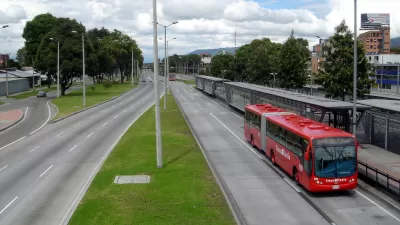
An article by Walter Hook and Annie Weinstock looks back at the first 20 years of operation for the TransMilenio bus rapid transit system in Bogotá, Colombia.
As mentioned in the article, TransMilenio is very much associated with former Mayor Enrique Peñalosa, who launched the system in 2000 and took charge of the system again in a second term that concluded in 2019.
Among Peñalosa’s contributions to the system, the article lists the formalizing of the city's informal public transport industry as a supplemental development initiative. By implementing a competitive bid process for TransMilenio operators, according to the article, working conditions improved for bus operators, bus services began operating on a schedule for the first time, and bus stops became safer for riders.
The article then turns to the work accomplished, as well as mistakes made, during the tenure of former Mayor Samuel Moreno. While bringing more of the informal transport industry under contract, the Moreno made several errors that offer critical transit planning lessons, such as poor integration between bus systems, problems with fare cards, and other problems with transit operators.
According to the article, Peñalosa’s second term expanded and stabilized the sytem. "[D]espite a major downturn in the system’s finances under the subsequent mayors who served between 2008 and 2016, the TM BRT had nearly returned to full cost recovery just before the pandemic, at the end of Peñalosa’s second term."
Still, Peñalosa's second term proved controversial (especially to some outside observers) helping propel Mayor Claudia López to office on a platform that included opposition to expansion plans proposed by Peñalosa. Since taking office, Colombia has been hit especially hard with the economic and public health consequences of COVID-19, and TransMilenio is facing a funding crisis like so many transit systems around the world. "In 2020 TM’s deficit increased by 135% percent compared to 2019, for a total of USD 610 million. Fare revenue dropped by around 50%."
According to the article, the challenges facing TransMilenio have also become intertwined with the national political upheaval in the country, but the opportunity to finally achieve affordable "world class BRT on much-needed trunk corridors integrated with a high-capacity metro through part of the urban core" is possible when the smoke from political violence clears in Colombia.
FULL STORY: TransMilenio 3.0: Integrating Metro and Informal Transit Citywide

Bogota's TransMilenio Turns 10
Bogota's integrated mass transit system has been operation for a decade and continues to grow, but faces challenges for the coming years, from the constant growth in ridership to irregularities in construction contracts.
Fighting Climate Change with Bus Rapid Transit
Bogota, Colombia's bus rapid transit system is seen as a shining example of how buses can make up a good public transportation system in cities. It's also being looked at as a model for fighting climate change.
Bogotá Commits to the Bicycle
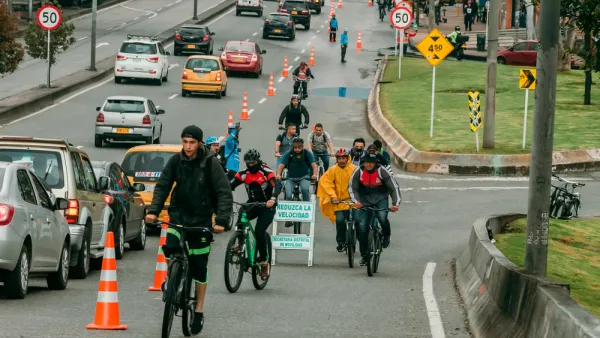
Colombia's capital city, the birthplace of the Ciclovía, is devoting public space to bikes during lockdown. To reduce traffic, the city plans to allocate even more public space to bike infrastructure and sustainable mobility moving forward.

Planetizen Federal Action Tracker
A weekly monitor of how Trump’s orders and actions are impacting planners and planning in America.

The state-sanctioned urbicide of Austin
People don’t kill cities. Freeways do.

US to reduce Colorado River water deliveries to Mexico
A new Colorado Treaty amendment reduces Mexico’s Colorado River water allocation by 250,000 acre feet.

5 New England states march closer to 800 megawatt wind energy project
Securing federal approval for the project may be complicated under the Trump administration, which has historically been hostile towards domestic wind power.

Baltimore to break ground on $50 million Transit Priority Project
The project will bring faster bus trips, safer streets and better bike connections to Baltimore.

Airbnb launches $250 million 'last-dollar financing' housing accelerator, makes first investment in Austin
The company will put $6.4 million towards affordable housing development in Texas’ capital.

FREE Course: Walkable City 1: Why Walkability?
After describing his path towards focusing on walkability as the essence of good planning, Jeff Speck marches through his five principal reasons for making more walkable places.
Reinventing Malls: Planning Alchemy—Turning Gray Fields Into Gold
The course focuses on the opportunities and imperatives that shape reinvention of mall sites.

Eagle County Government
Harvard University Graduate School of Design
Nashville Planning Department
The Architects Foundation
University of Cincinnati Online
The Pocatello Development Authority
The Urban Renewal Agency of the City of Pocatello
Journal of the American Planning Association