Cities and counties have been slow to take advantage of the promise of full and retroactive FEMA reimbursement to expand emergency housing programs, frustrating housing advocates. What’s getting in the way?



Over the last year, thousands of unhoused and vulnerable people have moved from the streets or congregate spaces into hotel and motel rooms thanks to a bevy of emergency housing programs aimed at reducing the spread of COVID-19. Shelterforce recently wrote about how these programs worked, and why some local governments were now purchasing hotels for long-term housing.
Though the need is still great, some of these emergency housing programs are winding down due to funding issues.
FEMA had been reimbursing cities, counties, and states 75 percent of the cost for COVID-related non-congregate shelter, but once other sources of funding ran out—like those provided by the federal CARES Act—local governments opted to shutter their hotel and motel lease programs.
There was cause for celebration earlier this year when the Biden administration announced that FEMA would provide 100 percent reimbursement for non-congregate shelter, retroactive to the start of the pandemic and through Sept. 30, 2021. Advocates said the move would make a major difference in the availability of COVID-safe shelter. “It will enable states and communities to address the urgent health and housing needs of people experiencing homelessness and other residents of congregate facilities during the pandemic,” the National Low Income Housing Coalition said in a statement after the announcement.
But cities and counties have so far been slow to take advantage of the promise of full and retroactive reimbursement to expand these emergency programs, frustrating many housing advocates. According to an investigation by Grist, only 23 local governments have submitted funding requests as of early April. What’s getting in the way?
FEMA Fears
It turns out several things are, among them the fact that ...
FULL STORY: FEMA Offers Full Reimbursement for Pandemic Shelter Costs—But Cities Are Still Jittery

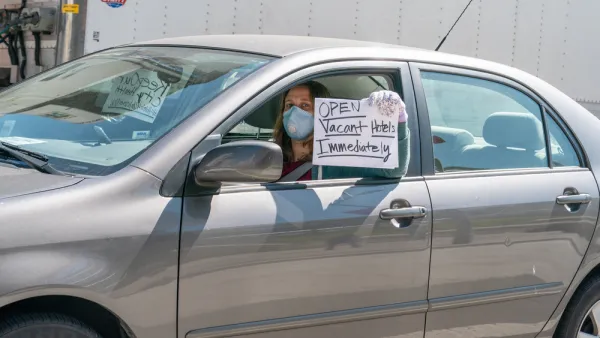
Hotels Could Play a Critical Role in Containing Coronavirus in Crowded Cities
Some cities are leasing entire hotels to provide rooms for people who have tested positive for COVID-19 or been exposed to infected people, to allow for safe and supportive isolation away from family or household members who risk being infected.
Late Action, Local Opposition Frustrate Emergency Homeless Shelter Plans
Some progress, but not nearly enough, has been reported as California and its cities scramble to procure temporary shelters to house homeless people during the pandemic.
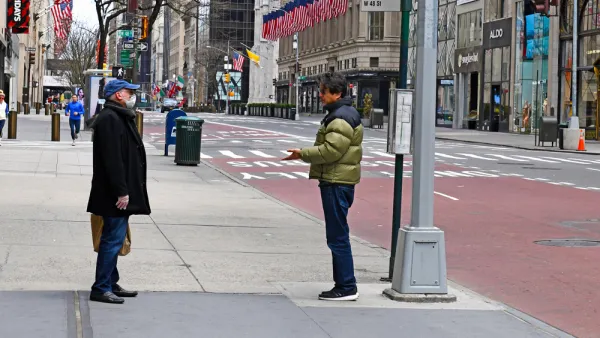
Friday Eye Candy: Covid-19, Then and Now
The New York Times compared images from readers portraying similar scenes in 2020 and 2022.

Planetizen Federal Action Tracker
A weekly monitor of how Trump’s orders and actions are impacting planners and planning in America.

The state-sanctioned urbicide of Austin
People don’t kill cities. Freeways do.

US to reduce Colorado River water deliveries to Mexico
A new Colorado Treaty amendment reduces Mexico’s Colorado River water allocation by 250,000 acre feet.

5 New England states march closer to 800 megawatt wind energy project
Securing federal approval for the project may be complicated under the Trump administration, which has historically been hostile towards domestic wind power.

Baltimore to break ground on $50 million Transit Priority Project
The project will bring faster bus trips, safer streets and better bike connections to Baltimore.

Airbnb launches $250 million 'last-dollar financing' housing accelerator, makes first investment in Austin
The company will put $6.4 million towards affordable housing development in Texas’ capital.

FREE Course: Walkable City 1: Why Walkability?
After describing his path towards focusing on walkability as the essence of good planning, Jeff Speck marches through his five principal reasons for making more walkable places.
Reinventing Malls: Planning Alchemy—Turning Gray Fields Into Gold
The course focuses on the opportunities and imperatives that shape reinvention of mall sites.

Eagle County Government
Harvard University Graduate School of Design
Nashville Planning Department
The Architects Foundation
University of Cincinnati Online
The Pocatello Development Authority
The Urban Renewal Agency of the City of Pocatello
Journal of the American Planning Association