The bill's author and housing advocates argue that easing parking requirements would ease the state's affordable housing crisis and promote the state's climate goals.


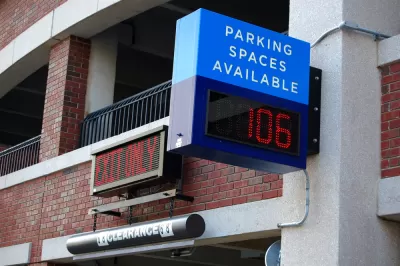
"It’s time to prioritize housing people over housing cars," argues the Los Angeles Times editorial board, writing in support of a new bill introduced by Assemblymember Laura Friedman (D-Glendale), which "would prohibit cities from requiring parking in developments within a half mile of a major transit stop or transit corridor." Under the proposed bill, builders can still provide parking, but blanket requirements would be eliminated.
"The state’s obsession with providing abundant parking means the cost of new construction, particularly for housing, is unnecessarily inflated." Assembly Bill 1401 "could help with two essential and sometimes overlapping goals: easing the housing crisis and reducing climate-warming emissions from vehicles."
"In some cities that are resistant to new development, stringent parking requirements are a de facto way of blocking higher-density multifamily housing and lower-income housing," encouraging the development of only high-end units that will give developers a higher return on their investment to make the project financially viable. According to one analysis, "building a parking structure added nearly $36,000 per unit." Easing parking requirements has had demonstrably positive effects on housing development. "Two decades ago, Los Angeles eased parking requirements to make it easier to convert old commercial buildings into apartments and condos. This adaptive reuse ordinance helped create nearly 7,000 units downtown by 2008."
Eliminating mandatory parking will also help the state reach its climate goals, the editorial board argues. "There’s simply no way California can meet its climate goals without slashing emissions from transportation." To reduce the need for private vehicles, "[i]t’s time to flip on its head the 'car is king' thinking that has shaped California’s development patterns for the last half-century."
In an op-ed published in Bloomberg CityLab, Assemblymember Friedman and UCLA Urban Planning professor and author of The High Cost of Free Parking Donald Shoup write that "[t]hese outdated planning policies make it difficult to build more multi-family homes within urban boundaries, fueling an unprecedented housing shortage that is entirely artificial in origin." Although they acknowledge that "parking reform isn’t a silver bullet to solve these problems, it is a vital ingredient — and one that’s already gaining traction: Many cities in California have already made the leap to break free from the high cost of 'free' parking." However, "these harmful requirements remain in place in most cities, reinforcing the need for statewide action to address California’s climate, transportation and housing challenges."
FULL STORY: Eliminate parking requirements: Housing people is more important than housing cars


Toronto City Council Removes Most Minimum Parking Requirements
The parking reform movement has a major new feather in its cap: the Toronto City Council has this week adopted sweeping changes to the parking requirements of the city's zoning bylaws.
The Perils of Central Planning for Parking
Donald Shoup, the author of the seminal planning book "The High Cost of Free Parking," explains how parking requirements have poisoned cities and why poor planning is to blame.
Berkeley to Remove Parking Requirements for Residential Properties
Berkeley is the second city in Northern California to approve landmark zoning reforms so far in 2021.

The state-sanctioned urbicide of Austin
People don’t kill cities. Freeways do.

US to reduce Colorado River water deliveries to Mexico
A new Colorado Treaty amendment reduces Mexico’s Colorado River water allocation by 250,000 acre feet.

New Jersey’s second-largest city bans standalone data centers
Jersey City will continue to allow co-location facilities, such as those meant for research institutions that store their own data.

Amtrak not solely to blame for New Jersey commuter rail's unreliability, report finds
A new study from the Garden State Initiative found that NJ Transit’s budget grew 20% across a 4 year period, but reliability declined significantly over the same period.

EPA erases limits on planet-warming pollution from power plants
Under Monday’s plan, power plants would still have some limits on how much mercury, arsenic and other contaminants they can emit.

Phoenix announces new on-demand transit service, more frequent RAPID buses
Both new services will launch in October, and are part of Phoenix's Project Effective Access Solutions for Easing Congestion.

FREE Course: Walkable City 1: Why Walkability?
After describing his path towards focusing on walkability as the essence of good planning, Jeff Speck marches through his five principal reasons for making more walkable places.
Reinventing Malls: Planning Alchemy—Turning Gray Fields Into Gold
The course focuses on the opportunities and imperatives that shape reinvention of mall sites.

Eagle County Government
Harvard University Graduate School of Design
Nashville Planning Department
The Architects Foundation
University of Cincinnati Online
The Pocatello Development Authority
The Urban Renewal Agency of the City of Pocatello
Journal of the American Planning Association