Travelers will be required to properly wear a face mask when riding all forms of public transportation, e.g., ride-share, bus, train, ferry, or plane. The rule applies to transportation hubs and boarding platforms. Not just any face-covering will do.


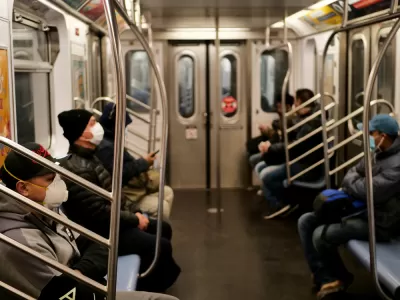
The Centers for Disease Control and Prevention (CDC) is back! On Saturday, the nation's health protection agency released a sweeping order to implement the second of President Joe Biden's two mask mandate executive orders designed to reduce the spread of COVID-19, responsible for the death of over 438,000 Americans since Jan. 21, 2020, according to the CDC.
Today’s order from CDC is part of a comprehensive, science-driven, U.S. government response to the COVID-19 pandemic. One component of the whole-of-government response is taking actions related to reducing virus spread through travel. Transmission of the virus through travel has led to—and continues to lead to—interstate and international spread of the virus.
"The CDC tried to push a mask mandate in public transportation during Donald Trump’s administration but was blocked from doing so and instead only issued a recommendation that all travelers wear masks," reports Daniel Politi for Slate.
Although airlines and most public transportation system already require masks, the CDC order means it will be easier to enforce the rules because those who refuse to wear one will be violating federal law.
Although criminal penalties are possible, the CDC said it doesn’t “intend to rely primarily on these criminal penalties but instead strongly encourages and anticipates widespread voluntary compliance.”
"The new order states masks must completely cover a traveler's nose and mouth," reports Evan Semones for Politico. "Face shields, scarves and bandanas are not permissible forms of coverings, the CDC said."
Airlines, which largely enforced self-imposed mask regulations before Biden’s order and the new CDC rule, previously called on the Federal Aviation Administration to issue a federal mask mandate, but the agency declined to, noting that it’s not a public health agency.
The order itself is quite explicit, listing the types and attributes of mask that are acceptable, and perhaps of more interest, those that do not meet the requirements:
-
Masks worn in a way that does not cover both the mouth and nose
-
Face shields or goggles (face shields or goggles may be worn to supplement a mask that meets above required attributes)
-
Scarves, ski masks, balaclavas, or bandannas
-
Shirt or sweater collars (e.g., turtleneck collars) pulled up over the mouth and nose.
-
Masks made from loosely woven fabric or that are knitted, i.e., fabrics that let light pass through
-
Masks made from materials that are hard to breathe through (such as vinyl, plastic, or leather)
-
Masks containing slits, exhalation valves, or punctures
-
Masks that do not fit properly (large gaps, too loose or too tight)
There are exceptions to the mask rule. CDC's "Requirement for Face Masks on Public Transportation Conveyances and at Transportation Hubs" is easy to read and includes FAQs.
Related in Planetizen:
-
Biden: Masks, Not Vaccines, Are Best Defense in Near Term, Jan. 26, 2021
-
Buses and Masks, January 11, 2021
-
Mask Mandates Without Enforcement Amount to Half-Measures, August 4, 2020
FULL STORY: CDC issues rule requiring travelers to wear face masks

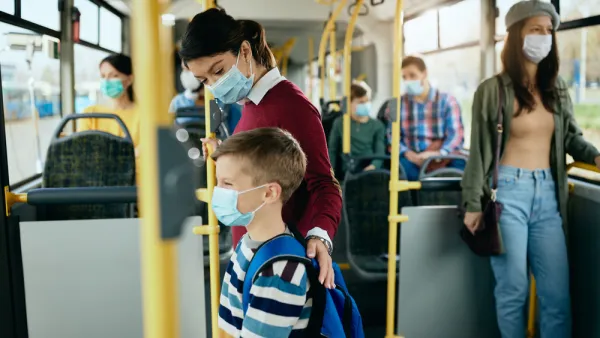
After Waiting Two Days, Justice Department Appeals Transit Mask Ruling
Mystery surrounds the decision by the Biden administration to not ask for an immediate stay of an unanticipated district court ruling to vacate the CDC's masks-on-transit rule. Two days later they appealed as coronavirus cases increase nationwide.
Biden: Masks, Not Vaccines, Are Best Defense in Near Term
President Joe Biden is calling on all Americans to wear masks for the next 100 days to mitigate the spread of the coronavirus, issuing two executive orders that require wearing masks on federal property and in domestic and international travel.
Biden Administration Targets Five States that Ban School Mask Mandates
President Biden asked his education secretary to see what could be done about states that prohibit school districts from enacting CDC public health recommendations. Miguel Cardona responded by empowering his Office of Civil Rights to investigate.

Planetizen Federal Action Tracker
A weekly monitor of how Trump’s orders and actions are impacting planners and planning in America.

The state-sanctioned urbicide of Austin
People don’t kill cities. Freeways do.

US to reduce Colorado River water deliveries to Mexico
A new Colorado Treaty amendment reduces Mexico’s Colorado River water allocation by 250,000 acre feet.

Mamdani overhauls NYC's Vision Zero plan with 100 new policy goals
The overhaul aims to reduce traffic deaths and make streets safer for pedestrians, cyclists and drivers through lower speed limits, new safety infrastructure and more.

Amtrak not solely to blame for New Jersey commuter rail's unreliability, report finds
A new study from the Garden State Initiative found that NJ Transit’s budget grew 20% across a 4 year period, but reliability declined significantly over the same period.

EPA erases limits on planet-warming pollution from power plants
Under Monday’s plan, power plants would still have some limits on how much mercury, arsenic and other contaminants they can emit.

FREE Course: Walkable City 1: Why Walkability?
After describing his path towards focusing on walkability as the essence of good planning, Jeff Speck marches through his five principal reasons for making more walkable places.
Reinventing Malls: Planning Alchemy—Turning Gray Fields Into Gold
The course focuses on the opportunities and imperatives that shape reinvention of mall sites.

Eagle County Government
Harvard University Graduate School of Design
Nashville Planning Department
The Architects Foundation
University of Cincinnati Online
The Pocatello Development Authority
The Urban Renewal Agency of the City of Pocatello
Journal of the American Planning Association