President Joe Biden is calling on all Americans to wear masks for the next 100 days to mitigate the spread of the coronavirus, issuing two executive orders that require wearing masks on federal property and in domestic and international travel.


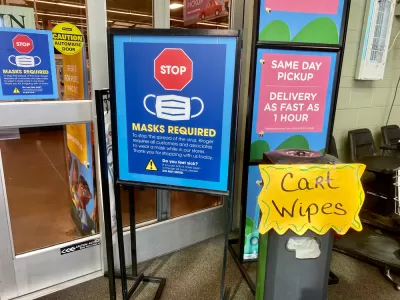
The emphasis on wearing masks marks one of the biggest differences with his predecessor who politicized and shunned them which undoubtedly contributed to increased COVID infections, now over 25 million; hospitalizations—over 110,000, and more than 420,000 deaths, according to The New York Times coronavirus tracker on Jan. 25.
"In the next few months, masks, not vaccinations, are the single best defense that we have against COVID-19," President Biden told the nation's mayors on Jan. 23 during the final full day of the United States Conference of Mayors’ 89th Winter Meeting held virtually.
"Medical experts say by wearing masks from now until April we will save more than 50,000 lives. We're asking the American people to mask-up for the first 100 days.
"I've issued an executive order requiring masks on federal property and interstate travel like trains, planes, and buses. I hope we can work together so you can require mask-wearing in your cities and social distancing."
"Together, the two orders come as close to a national mask mandate as his federal powers may allow, leaving it to states and municipalities to require residents to wear masks at a local level," report and William Wan for The Washington Post.
Masks represent the lowest-hanging fruit of public health measures that could put a dent in the outbreak, as science shows how dramatically they reduce transmission of the virus.
“It is, in some ways, our best medical tool,” said Ali Mokdad, an epidemiologist at the Institute for Health Metrics and Evaluation at the University of Washington. “It can save hundreds of thousands of lives without the need for surgery, drugs, no side effects and readily available to everyone.”
"Masks have become a partisan issue, unfortunately, but it's a patriotic act," stated Biden when signing the second of the two executive orders on Jan. 21 (see video attached to the source article).
"But for a few months, to wear a mask, [with] no vaccines; the fact is that they're the single best thing we can do. They're even more important than the vaccine because they take time to work...So I'm asking every American to mask up for the next 100 days."
Why not a real national mask mandate?
The two orders are a disappointment to those who hoped for an actual national mandate, similar to what 37 states plus D.C. and Puerto Rico have issued.
"Such a requirement would have been likely to be challenged in court by anti-mask activists, who have argued that only states and municipalities have the power to require residents to wear masks at a local level," add Wan and Laris in a follow-up FAQ piece on the two orders that includes enforcement, effective date, and outdoor federal properties.
Others, however, have argued that these are unprecedented times and that a national mask mandate would send a message and reflect the seriousness of the crisis.
Intrastate transportation?
Biden used the term, "interstate travel," in his aforementioned address to the nation's mayors, but that's not what his order states. Jeff Davis of the Eno Center for Transportation was surprised to see the inclusion of "all forms of public transportation as defined in section 5302 of title 49, United States Code" in the "Executive Order on Promoting COVID-19 Safety in Domestic and International Travel." Davis writes:
The presence of mass transit as item was a bit of a surprise. During the campaign, Biden’s promised mask mandate only applied to interstate transportation, which made sense, because that is the area where the federal government has general police power to regulate and to ensure public safety. Intrastate transportation, like most mass transit, is not an area where the federal government generally has regulatory power.
The mandates for the various modes must be issued by the appropriate agencies, including the Department of Transportation, the Federal Aviation Administration, and the Coast Guard. The order gives "agency leaders a week to brief Jeffrey Zients, coordinator of the White House’s coronavirus response, on their progress," add Wan and Larris.
Related in Planetizen:
-
Buses and Masks, January 11, 2021
-
Most Mayors Share Similar Priorities in Coronavirus Recovery, October 8, 2020
-
Can the Public Be Educated to Wear Masks? October 5, 2020
-
Is it a COVID Car or Mask-Optional Car? Rail Commuters Decide, September 28, 2020
-
Mask Mandates Without Enforcement Amount to Half-Measures, August 4, 2020
-
Rift Grows Between U.S. Conference of Mayors and the White House, January 25, 2018
FULL STORY: Biden signs order requiring masks on planes, buses, trains and at airports

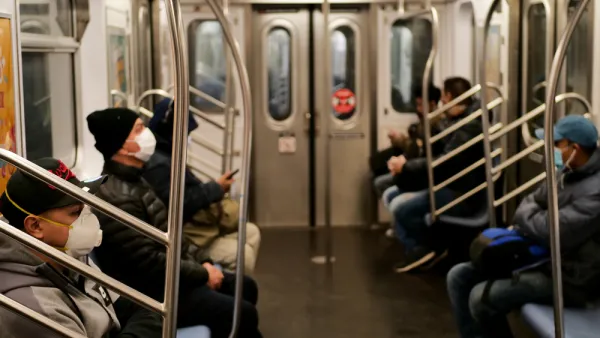
CDC's New Face Mask Requirement on Transit Takes Effect Tuesday
Travelers will be required to properly wear a face mask when riding all forms of public transportation, e.g., ride-share, bus, train, ferry, or plane. The rule applies to transportation hubs and boarding platforms. Not just any face-covering will do.
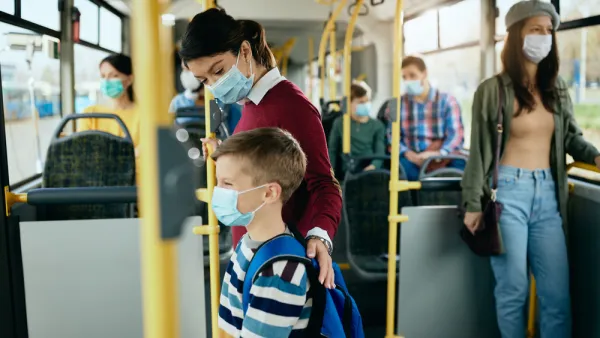
After Waiting Two Days, Justice Department Appeals Transit Mask Ruling
Mystery surrounds the decision by the Biden administration to not ask for an immediate stay of an unanticipated district court ruling to vacate the CDC's masks-on-transit rule. Two days later they appealed as coronavirus cases increase nationwide.
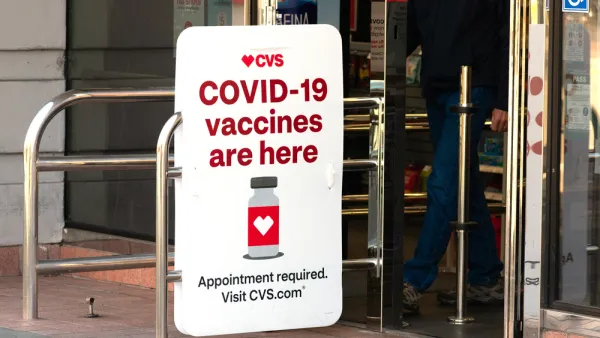
Will CDC's Revised Guidance for Fully Vaccinated People Prolong the Pandemic?
The CDC abruptly changed its masking guidance on May 13 to further distinguish behavior for those who are fully vaccinated from those who are not, prompting states, counties and businesses to end indoor mask mandates and social distancing.

Planetizen Federal Action Tracker
A weekly monitor of how Trump’s orders and actions are impacting planners and planning in America.

The state-sanctioned urbicide of Austin
People don’t kill cities. Freeways do.

US to reduce Colorado River water deliveries to Mexico
A new Colorado Treaty amendment reduces Mexico’s Colorado River water allocation by 250,000 acre feet.

5 New England states march closer to 800 megawatt wind energy project
Securing federal approval for the project may be complicated under the Trump administration, which has historically been hostile towards domestic wind power.

Baltimore to break ground on $50 million Transit Priority Project
The project will bring faster bus trips, safer streets and better bike connections to Baltimore.

Airbnb launches $250 million 'last-dollar financing' housing accelerator, makes first investment in Austin
The company will put $6.4 million towards affordable housing development in Texas’ capital.

FREE Course: Walkable City 1: Why Walkability?
After describing his path towards focusing on walkability as the essence of good planning, Jeff Speck marches through his five principal reasons for making more walkable places.
Reinventing Malls: Planning Alchemy—Turning Gray Fields Into Gold
The course focuses on the opportunities and imperatives that shape reinvention of mall sites.

Eagle County Government
Harvard University Graduate School of Design
Nashville Planning Department
The Architects Foundation
University of Cincinnati Online
The Pocatello Development Authority
The Urban Renewal Agency of the City of Pocatello
Journal of the American Planning Association